QUI TAKEAWAY: If you advertise “Satisfaction Guaranteed”, what would you do differently? Do more. Do better. Do it now. When it comes to your customers and customer service, don’t just be good. Be GREAT out there!
You are happy because customers were satisfied with their purchase of your product or a resolution with your service. But that’s not good enough. Your satisfied customers feel that their experience is good, not better, just average. Nobody raves about average. And satisfied customers will not return as soon as they find an experience that is better or a price that is less expensive. On the flipside, with your GREAT customer CARE, your customers are willing to pay for their experience, no matter the price.
So, when it comes to customers and customer service, well, you get it. And if you don’t, you better.. Otherwise, you’d go broke. Literally. So …
Despite the business turmoil of the pandemic, Skimpflation, The Great Resignation, quiet quitting, and, now, the recession, envision a time when your business will, not only survive but, soon, thrive and succeed. Just exactly when is that time? Well …
Now is the time for a People First Revolution! One caveat is Employees First. Business leaders see themselves as bosses, hierarchical rungs well below their subservient “employees first” at the bottom of the ladder. With a “People First” culture, no longer are people taking second or third seats to profits or customers. Your people’s emotional well-being would take priority over your business’s financial health.
With that your People First in mind, whether your position or title, be a servant leader who will CARE for your people.
COMMUNICATE openly, transparently, interactively, frequently, and continuously any information that their people need and want to know. Listen empathetically to the people’s concerns, questions, and complaints. Express compassion with their recommendations and encouragement.
APPRECIATE the important roles and responsibilities of their people.
RECOGNIZE and offer accolades for your people’s individual and team accomplishments and acts of service to colleagues or customers.
EMPOWER people to make the right decisions for themselves, their colleagues, customers, and your business.
As a servant leader, ask your people two questions:
What do you think?
What can I do for you?
When you ask, promptly respond, and take action as appropriate, your people will feel valued and respected. They’ll be inspired, energized, and empowered to develop themselves. and engage their colleagues their customers and you and your business.
When you create a GREAT experience for your people, they will do the same for your customers, and you will earn the loyalty of both. Soon, without a focus on profits, your profits will grow. And everyone, your people, your customers, you and your business, will be enriched, literally and figuratively.
So what are you waiting for? Now is the time. It’s time for a People First Revolution! First, you will be best for your people, and then you will be first among your competitors.
The value to your customers is in their personal interactions, not your “cash or credit” business transactions.
Your relationship with your customers, not their purchase of your product or service, is where true value flows.
QUI QUOTE: Relationship capital is the only currency of value to grow your business. So, when it comes to customers and customer experience, think RELATIONSHIPS or go broke. Literally.
English writer Samuel Johnson said, “People need to be reminded more than they need to be instructed.” So when you prepare your team to engage and WOW your customers, I encourage you to remind them when you say, “Nobody raves about average. Don’t be just good. Be GREAT out there!”
QUI QUOTE: Nobody raves about average. Don’t be just good. Be out there!
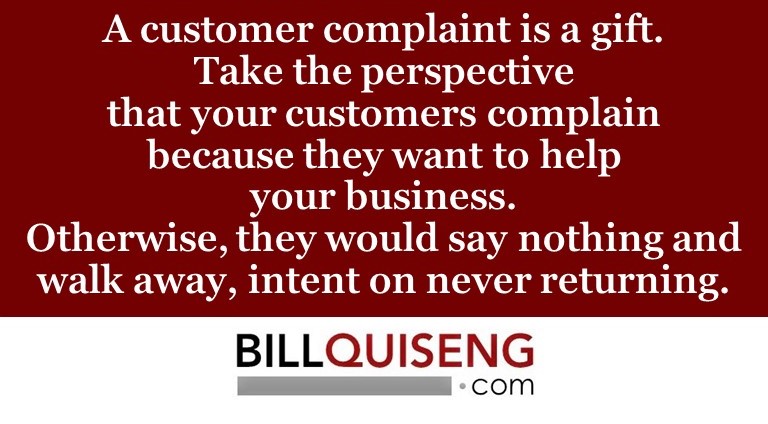
QUI QUOTE: A customer complaint is a gift. Take the perspective that your customers complain because they want to help your business. Otherwise, they would say nothing and walk away, intent on never returning.
A customer may not always be right. But they are always your customer. Do whatever it takes to make them feel right.
Listen and allow the customer to vent. Angry or frustrated customers generally will not listen to or accept your apology until they have an opportunity to voice their frustrations.
And listen to their complaints with the intent to take action, not to give an explanation. To a customer, when something is wrong, your explanation is an excuse. Customers want action, not excuses.
Listen empathetically, apologize, and do whatever it takes to resolve the problem, even if it means having to go with your customer to your competitor.
When all alternatives don’t work, DON’T fire the customer. Simply ask the customer to resign. “I’m sorry but I’m not able to resolve your problems. Could I recommend Company X for your experience? I could contact them if you like.” Both the customer and your competitor are happy. The customer will remember you and might be loyal to you. Your competitor is happy because you recommended them. They may refer you later when they could not resolve another customer’s complaint. A Mutual Admiration Society of sorts.
When a customer complains, take it personally. Take it professionally. Take it responsibly. Just don’t take it home.
For many years, there has been a stranglehold “Profits over People” mentality for healthcare leaders. These “Profits over People” traditionalists care about their hospital’s labor, research, and equipment costs, Medicare reimbursements, pharmaceutical companies’ payments in cash and in-kind gifts, and their patients’ payments more than they do their patients. Listening to the sweet cha-ching sound of profits, these traditionalists do not hear the concerns and complaints of their patients and their caregivers. They care more about profits and didn’t care much about their patients.
Well, no more! To paraphrase John DiJulius’ customer service battle cry, it’s time for a Patient CARE Revolution! Let’s be revolutionary to improve the patient experience. This revolution “is a radical overthrow of conventional business mentality, designed to transform what” patients “experience. This shift produces a culture that permeates into people’s personal lives, at home, and in the community,” says DiJulius.
Instead of focusing on the hospital’s financial health, doctors should focus on the patient’s emotional well-being. Whether healthcare professionals know it or not, patients seek the best emotional value in their experience, not just a remedy to their physical ailments. Patients don’t care how big the hospital is. They only care about how big the doctors and nurses care about them. So rather than focusing on healthcare, doctors and nurses should focus on patient care and CARE for their patients.
COMMUNICATE with each patient with a smile, eye contact, and polite interaction. Inform each patient and caregiver transparently and interactively of the ailment, prognosis, medications, therapy, and recovery outcomes.
ACKNOWLEDGE each patient’s emotional presence and value to the doctor and nurse,
RESPOND promptly and empathetically to each patient’s and caregiver’s angst, questions, concerns, and complaints.
ENRICH the experiences and, ultimately, the lives of every patient.
And when doctors and nurses CARE, their patients and caregivers are WOWED, grateful and happy, raving to others on social media.
So let’s be revolutionary to improve the patient experience and have doctors and nurses CARE for their patients. When healthcare professionals engage with their emotional, human patients, everyone’s lives will be enriched.
This is our time. Let’s be loud and proud. Let’s be revolutionary! And let’s make healthcare professionals be GREAT out there! Vive la revolution!
This June, I present each one of the Three Principles to Build Customer Loyalty. In this third week, here is Principle Three:Be Magnificently Boring!
You have been happy that your customers leave satisfied. You have sold them a product or service that meets their wants or needs. Or you solved their problem for them. You were happy because, in the end, they were satisfied. But that’s not good enough. Satisfied customers feel their experience is good, not better, just average. Nobody raves about average. And satisfied customers will leave when they find an experience that is better or a price that is less expensive.
So, don’t serve to sell to customers. And don’t serve to satisfy customers. Don’t treat customers as they would expect to be treated. And don’t follow the Golden Rule to treat them as you want to be treated. Instead, treat them a little better than they want to be treated. Serve to WOW them.
Be Magnificently Boring!
Customer loyalty is not ONE BIG WOW to a customer. It’s one little wow delivered consistently to every guest. Be Magnificently Boring!Consistently deliver a low-cost, no-cost “a little better than the average experience that customers expect” product or service so tediously repetitive that you feel it is boring, but to the customer, at that moment, you are Magnificent! For retailers, start opening 10 minutes earlier and closing 10 minutes later. For hotels, offer bottled water at arrival and departure. For auto service repair businesses, wash the car before returning the vehicle. For restaurants, personalize the menu with the customers’ names and any special occasions, such as birthdays or anniversaries.
But being Magnificently Boring may not be good enough for some customers. So, remember that customers pay for THEIR experience, not yours. They buy with emotion and justify their decision with reason. They seek the best emotional value in their entire experience, not the minutiae of your logically reasonable best price, product, or service, virtual or physical locations, AI, live chat, or face-to-face customer support, or the many other small details of your experience. So, if other businesses have delivered Magnificently Boring products or services, technological advances, and AI interactions to their customers, you have to do better.
Customers don’t seek B2B or B2C businesses. They engage in businesses that are H2H. Human to Human. One to One. Heart to Heart. Customers don’t care how big your business is. They only care how big you care about them. So, CARE BIG! Serve to WOW them! Serve to CARE.
COMMUNICATE with every customer with a smile, eye contact, and polite interaction. Inform each customer transparently and interactively of the product’s or service’s function, liabilities, and advantages to them. Listen empathetically to understand the customer’s questions, concerns, and complaints.
ACKNOWLEDGE each customer’s presence and value to you and your business.
RESPOND promptly and empathetically to each customer’s questions, concerns, and complaints.
ENRICH the experiences and, ultimately, the lives of every customer.
Be Magnificently Boring to CARE!
Consistently CARE for your customers so repetitively that you feel it is boring, but to every customer, at that moment, you are Magnificent! And when you do, customers have an emotional connection. The more emotional the connections, the more memorable the experiences, and the more loyal the customers are. Loyal customers will return, again and again, raving about you to others.
The value to your customers is in their personal interactions, not in your “cash or credit” business transactions. When it comes to customers and customer experience,
Think RELATIONSHIPS or Go Broke. Literally.
Magnificently Boring consistency builds trust. Trust builds relationships. Relationships build loyalty. Loyalty builds your business. So,
Be Magnificently Boring! and Be Magnificently Boring to CARE!
English writer Samuel Johnson said, “People need to be reminded more often than they need to be instructed.” So, as you prepare your team to engage your customers, I encourage you to remind them when you say, “Let’s not be just good. Let’s be GREAT out there!”
During the month of June, I will offer each one of the Three Principles to Build Customer Loyalty. In this first week, I give you Principle One: Be the Customer.
“Customers perceive service in their own unique, idiosyncratic, emotional, irrational, end-of-the-day, and totally human terms. Perception is all there is!” Tom Peters.
Did you know that FedEx delivery people never run? They are told not to run. Do you know why? It’s because if their customers saw them running, those customers might FEEL that FedEx was running late. And that is NOT what FedEx wants to project. Their performance standard that they tell their drivers is “Walk quickly with purpose.” FedEx does that because they know that to customers, image is everything, their feelings are facts, and their perception is reality.
When I say, “County Fair”, what do you remember and feel about that experience? If I asked, “What do the grounds look like at the County Fair”, what is your perception? You can “see” the half-eaten corn cobs and the cotton candy sticks on the grounds. What if I say, “County Fair restrooms”? You probably remember someone shouting before you left home, “Everyone, go now because you don’t want to go when you are at the fair.” When you are looking for the porta-potties, you DON’T want to see what’s behind door #2. What about if I said, “County Fair ride operator”? What is your perception? Probably something like this:
Now I say to you, “Disney”, and I say the same three things. What do the grounds look like? You can picture the hedge that’s cut to look like Mickey Mouse. What do the restrooms look like? I’ve done this presentation for thousands of people and no one has ever said that the restrooms were dirty. What about the ride operator? Let me tell you what the grooming standard is for a male ride operator at Disney. Hair can not touch the back of the collar in a standing position. All facial hair (beards, goatees, and mustaches) must be fully grown in, neatly groomed, and well maintained and no longer than 1/4 of an inch in length. Mustaches may extend below the corners of the mouth to meet with the facial beard. Cast Members without a mustache, beard, or goatee are expected to be clean-shaven every day. Why is that? Because Disney understands their customer. When mom and dad and the kids are in Orlando deciding to go to Universal, Sea World, or Disney, who chooses? Mom or Dad? Mom. Disney knows that the mother is the decision maker. And what are the two things important to the mom when bringing her children to an unfamiliar place? #1 is Safety. So that is why everyone at Disney is dressed in costume so that if a child gets lost, he or she will gravitate to someone in costume instead of someone dressed like us on vacation. What’s #2 important to Mom? Cleanliness. That’s why Disney makes sure that their restrooms are immaculate. And why the strict grooming standard? Because Disney knows that if you aren’t being brought to Disney by your parents, you’re being brought by your grandparents. Ask any grandparent, would you mind leaving your grandchild with that employee, the one over there with the long hair, tattoos, and body piercings? What is Grandma going to say? “No way! If he’s not ON drugs, he’s probably selling drugs.” That employee could be the most polite person, but it doesn’t matter. All that matters is how Grandma FEELS. And her feelings are her facts.
Customers don’t seek B2B or B2C businesses. They engage in businesses that are H2H. Human to Human. One to One Heart to Heart. Customers buy with emotion and justify their decisions with reason.
QUI Takeaway: To earn customer loyalty, don’t get inside their heads. Get inside their hearts. Create an emotional connection. Don’t just think like the customer. Be the customer.
Every week, in the month of June, I will offer each one of the Three Principles to Build Customer Loyalty. Why only three? Because nobody can remember Number Four. Who is the first President of the United States? Surely, George Washington. Who is Number Four? Who is the first person to walk on the moon? Neil Armstrong, of course. Who is Number Four? (By the way, the answers to who is Number Four are James Madison and Alan Bean.)
For starters, let me give you these simple definitions: Customer service is what you do for your customers. Customer experience or CX is how your customers feel about what you do. Customer experience management or CXM is what you do before, during, and after your customers feel about what you did. And customer loyalty is how your customers feel about what you did over and over again.
Speaking about customers and customer experience, business leaders are happy because customers leave satisfied with their product or service. But that’s not good enough. Satisfied customers will feel that their experience is good, not better, just average. Nobody raves about average. And satisfied customers will not return as soon as they find an experience that is better or a price that is less expensive.
Rather than satisfying your customers, you have to deliver an experience that is better than satisfactory. Don’t treat your customers as they expect. And don’t treat your customers as you expect to be treated. Instead, treat them a little better than they expect. Don’t serve to satisfy them. Serve to WOW them. Your customers will have an emotional connection. The more emotional the connections, the more memorable the experiences, and the more loyal your customers are.
So here are Three Principles to Build Customer Loyalty.
PRINCIPLE ONE: Be the Customer.
PRINCIPLE TWO: Create Their Experience.
PRINCIPLE THREE: Be Magnificently Boring!
Once you understand the Three Principles to Build Customer Loyalty, then you need to consistently deliver them. When you do, your customers will be WOWED and happy, loyally returning again and again, raving to others on social media.
Customers pay for their experience, not your product or service. They buy with emotion and justify their decision with reason. Customers seek the best emotional value in their experience, not your logically reasonable price, product, or service.
The value to your customers is in their personal interactions, not your “cash or credit” business transactions. To earn customer loyalty, don’t get inside their heads. Get inside their hearts. Create an emotional connection. Think RELATIONSHIPS or Go Broke. Literally.
QUI QUOTE: Your customers don’t care about your NPS, CSAT, or CX metrics. They only care about theirs: One to One. Human to Human. Heart to Heart
"People need to be reminded more often than they need to be instructed."
Samuel Johnson
This blog, along with my Facebook, Instagram and Twitter pages, offer practical tips, insight and inspiration to serve as reminders on how to improve your personal delivery of customer service.