Tag Archives: customer service training

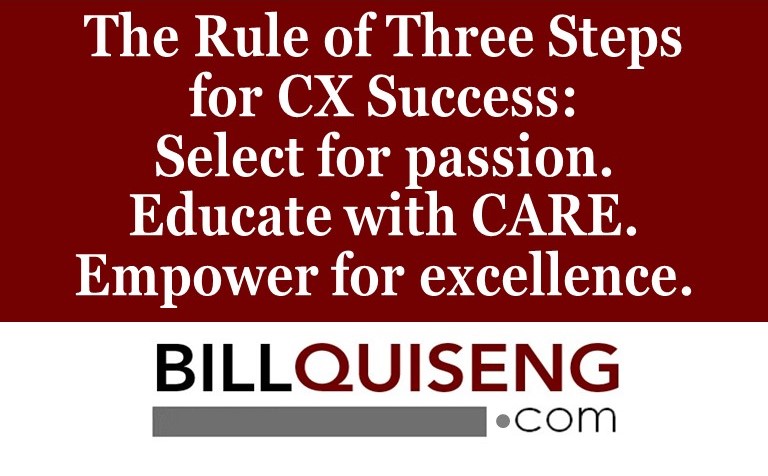
The Rule of Three Steps for CX Success: Select for passion. Educate with CARE. Empower for excellence.

The Rule of Three Steps for CX Success: Select for passion. Educate with CARE. Empower for excellence.

Select for passion. Serving customers because you HAVE TO is a job. Serving customers because you WANT TO is a passion. Find that passion. Don’t hire an employee. Soon, employees will see for themselves and tell each other that their “profits over people” bosses care about topline revenue, bottom-line profits, stock price, market share, and even their competitors more than they do the people, their subservient employees. Bosses don’t care much about their employees and their employees could care less about the bosses or customers and will soon leave. Instead, select people for passion. Then …

Educate with CARE. Don’t train your employees. Training is finite (usually one to four days), one way, “I know everything, you know nothing,” instruction. Instead, educate your people interactively, frequently, and continuously with customer CARE, like telephone etiquette, service recovery, and prompt, polite, and personalized interactions. Then …

Empower for excellence. Whatever your title or position, be a servant leader who will CARE for your people.

  • COMMUNICATE openly, transparently, interactively, frequently, and continuously any information your people need and want to know. Listen empathetically to the people’s concerns, questions, and complaints. Express compassion with your recommendations and encouragement. 
  • APPRECIATE the important roles and responsibilities of your people.
  • RECOGNIZE and offer accolades for team and individual accomplishments and acts of 
  • service.
  • ENRICH the experiences and ultimately the lives of your people. 

When you select for passion, educate with CARE, and CARE for your people, your people will feel respected, appreciated, and valued. With your support and encouragement, inspire and empower them to develop themselves and engage customers. When you create a GREAT experience for your people, they will do the same for your customers, and you will earn the loyalty of both. The experiences and lives of everyone, your people and your customers, you and your business, will be enriched.  

QUI TAKEAWAY: Don’t hire employees and train them on good customer service. Instead, select people for passion and educate them with customer CARE. Don’t let them be just good. Empower them to be GREAT out there!

#customerservice #customerexperience #employeeexperience #employeeengagement #custserv #custexp #cx. 

1 Comment

Filed under Customer Experience, Customer Loyalty, Customer Satisfaction, Customer Service, Employee Engagement, Training

Introduction to CX 101.

Welcome to CX 101. Today’s course is a prerequisite for business professionals in the B2C or hospitality industry. It’s an elective for the B2B or the online/digital industry.

This is not a customer service training class. Training is finite, usually one to three days. And training is top-down, one-way “I know everything, you know nothing” instruction. Training is to develop THE BUSINESS. Training is for a job. And the job of employees is to serve to satisfy the customer.

Instead, our education classes are interactive. With suggestions, recommendations, and encouragement, we empower you and your colleagues to develop YOURSELVES. Ideally, all of you will be enthused and energized to engage customers, not just to satisfy, but to WOW them.

So let’s get started.

Customer service is what you do for your customers. Customer experience is how your customers feel before, during, and after what you do. Customer experience management is what you do before, during, and after you find out how customers feel about what you did. Customer loyalty is how your customers feel about what you did repeatedly.

Customers pay for their experience, not your product or service. And it’s THEIR experience, not yours. They buy with emotion and justify their decision with reason. Customers seek the best emotional value in their entire experience, not the minutiae of your best price, product, or service, virtual or physical locations, AI, online, chatGPT, or face-to-face customer support, NPS, CSAT or other CX metric, or the many other details of your business experience.

You are happy because your customers are satisfied with their experience. You met their expectations. But that’s not good enough. Satisfied customers feel that their experience is good, not better, just average. Nobody raves about average. And satisfied customers will not return as soon as they find a better experience or a less expensive price. So you have to do more than satisfy your customers. Don’t just serve to sell to customers. And don’t serve to satisfy customers. Serve to WOW them.

Next week’s class is postponed until Valentine’s Day.

So the next class two weeks from now: How to serve to WOW your customers.

Before next week’s class, are there any questions? Whether you agree or agree to disagree, discuss or not, I’m sure that we can interact with each other without being disagreeable. So, I invite you to share your questions and comments.

English writer Samuel Johnson said, “People need to be reminded more often than they need to be instructed.” So as you prepare yourself every morning to engage to WOW your customers, I encourage you to remind yourself when you say, “Don’t be just good. Be GREAT out there!

#customerservice #customerexperience #custserv #custexp #cx

Leave a comment

Filed under Customer Experience, Customer Loyalty, Customer Satisfaction, Customer Service, Training

This is our time for a CX Revolution! Part Three.

Three weeks ago, I introduced the Rule of Three QUI TAKEAWAYS which will be revolutionary now, but once discussed many times over, will be viewed as traditional by many business professionals. In the last two weeks, I explained the first and second QUI TAKEAWAYS: CX versus CXM, and customer service versus customer CARE. In the next week, join me as we revolutionize the CX experience. This week, I will explain the third QUI TAKEAWAY: customer service training versus customer CARE education.

QUI TAKEAWAY: Don’t offer customer service training. Training is finite, usually one to three days. And training is top-down, one-way “I know everything, you know nothing” instruction. Training is to develop THE BUSINESS. Training is for a job. And the job of employees is to serve to satisfy the customer. In the end, training instructs people on how to TAKE CARE of the customer.

Instead, have business people enroll in Customer CARE University. We don’t have trainers or instructors. We have mentors and coaches. Our education classes are interactive. As mentors, educate your people with customer CARE actions to practice their interpersonal skills. They will learn and appreciate the value of telephone etiquette, service recovery, and customer CARE. After graduation, as coaches, remind them of your customer CARE excellence strategies. With suggestions, recommendations, and encouragement, empower your people to develop THEMSELVES and engage customers. Your people will create an emotional connection with their customers. The more emotional the connections, the more memorable the experiences, the more loyal the customers. Loyal customers will repeatedly return, spend more money, and rave about their WOW experience to others on social media.

In Customer CARE 101, your passion is to CARE for your people.

  • COMMUNICATE openly, transparently, interactively, and frequently any customer CARE information your people need or want to know. Listen empathetically to their suggestions, concerns, and complaints.
  • APPRECIATE their roles, responsibilities, actions, suggestions, and recommendations.
  • RECOGNIZE, honor, and offer accolades for their role-playing acts of customer CARE.
  • EMPOWER your people to act on their own to do what is right for them, their colleagues, their customers, and your business.

In Customer CARE 102, educate your people on how to CARE for their customers:

  • COMMUNICATE with each customer with a smile, eye contact, and polite interaction. Inform each customer transparently and interactively of the product’s or service’s function, liabilities, and advantages to the customer.
  • ACKNOWLEDGE each customer’s presence and value to the customer CARE person and your business.
  • RESPOND promptly and empathetically to each customer’s questions, concerns, and complaints.
  • ENRICH the experiences and, ultimately, the lives of every customer.

And, yes, educate everyone. Don’t just educate customer CARE representatives. Educate the people in the business who don’t need to CARE for their customers. When you create a GREAT experience for everyone as much as customer CARE representatives need to with their customers, you will earn the loyalty of both. Soon, without a focus on profits, profits will grow. Everyone, the people, their customers, the leaders and their businesses, and you and your business, will be enriched.

NEXT WEEK: Now is the time for a CX Revolution! Part Four.

#customerservice #customerexperience #customerloyalty #customerservicetraining #custserv #custexp #cx

1 Comment

Filed under Customer Experience, Customer Loyalty, Customer Satisfaction, Customer Service

This is our time for a CX Revolution!

Many CX professionals have advocated CX as strategies that explain customer journey mapping, the Peak End Rule, or innovative speed technologies among others. And they’ve done it so often for so long that “CX” has been the traditional term for many business leaders. But no more. This is our time for a CX Revolution!

To paraphrase John DiJulius’ battle cry, it’s time for a CX Revolution! Let’s be revolutionary to transform CX Into CXM, customer service to customer CARE, and customer service training to an education in customer CARE or customer CARE University.

Even though we want to revolutionize CX, we will still follow the Rule of Three. Why only three? Because nobody can remember Number Four. Neil Armstrong was the first man to walk on the face of the moon. It was number four? George Washington was the first President of the United States. Who was number four? Who was the first president of the United States? Of course, George Washington. Who was Number Four? Who was the first person on the moon? Neil Armstrong. But who was Number Four?

Why do we have so much difficulty in remembering who is Number Four? It’s because most of us can only remember up to three things. In the very beginning, there were only three TV channels using only three letters: ABC, NBC, and CBS. We remember our favorite sports leagues like the NFL, NBA, MLB, and NHL. Aladdin’s genie had three wishes. The Werewolf confronted Three Little Pigs. And Goldilocks stumbled onto the home of the Three Bears. When you were in school, what did they teach you if you were ever to catch on fire? Stop, Drop, and Roll. If good things come in threes, what does that make Number Four?

With that in mind, here are three QUI TAKEAWAYS that will be revolutionary at first, but once discussed many times over, will be viewed as traditional by many business professionals.

QUI TAKEAWAY: CX versus CXM

QUI TAKEAWAY: Customer service versus customer CARE

QUI TAKEAWAY: Customer service training versus customer CARE education 

I’ll explain the first QUI TAKEAWAY. The other two will come separately in the next two weeks.

First QUI TAKEAWAY: Customer service is what you do for your customers. Customer experience is how your customers feel about what you did. Customer experience management is what you do before, during, and after you find out how customers feel about what you did. Customer loyalty is how your customers feel about what you did again and again.

Customers pay for their experience, not your product or service. And they pay for THEIR experience, not yours. It’s all about them, never about you. Business management expert and author @Tom Peters said, “Customers perceive service in their own unique, idiosyncratic, emotional, irrational, end-of-the-day, and totally human terms. Perception is all there is!”

In other words, customers buy with emotion and justify their decision with reason. They seek the best emotional value in their entire experience, not the minutiae of your best price, product, or service, virtual or physical locations, AI, chatGPT, online, live chat, telephone, or face-to-face customer support, and the many other details of your business experience. In this their experience, not yours. So, it’s the best emotional value in their experience, not your best customer journey mapping, Peak End Rule, NPS, CSAT, CES or other CX metric strategy of your experience.

You may have been happy because your customers felt satisfied with their experience. But that’s not good enough. Satisfied customers feel that their experience is good, not better, just average. Nobody raves about average. And satisfied customers will leave as soon as they find an experience that is emotionally better or a price that is less expensive.

In the end, customer experience or CX  is about the emotional value of the experience of customers. Customer experience management or CXM is how businesses prioritize the best emotional value for their customers over the best  product, service, or technology, or CX strategy of your business experience. 

Revolutionary now. But later, oh, so traditional. 

Stay tuned for the second QUI TAKEAWAY. 

#customerservice #customerexperience #custserv #custexp #cx

1 Comment

Filed under Customer Experience, Customer Satisfaction, Customer Service

Learning about customer service should not be seen as an event, but rather as a process.

A wife walks into the living room where her husband is reading. She leans over and whispers “I love you.” Nothing. She repeats louder, “I love you.” Complete silence. She stares at him and asks, “I say I love you a LOT to you. You NEVER say I love you back. Why is that?” Her husband turns to her and declares, “Look, I told you I loved you when we got married. If that should change, I’ll let you know.” Now, is that enough? Of course not. If you want love to flourish, you have to be reminded every so often.

It’s the same for customer service. You already know what customer service is, but to make it flourish, you and your team need to be reminded periodically. If you want to drive customer loyalty, you cannot see customer service training as attending only one finite event, but rather you must see it as a participant in a continuous process.

# # #

Just a little over a year ago, I authored a blog post that implied that customer service training is good, not better, just average. Nobody raves about average. So, I offered people a continuous education in customer CARE. If you missed it, just follow it here:

And if you haven’t followed me on customer CARE, just find that here:

When it comes to customers and customer service, don’t just be good. Be GREAT out there!

#customerservice #customerservicetraining #custserv 

Leave a comment

Filed under Customer Service, Training

Select for passion, not past performance.

Instead of “Hire for attitude, not aptitude” or “Hire for personality, train for skills”, remind yourself when you recruit to

Select for passion, not past performance.

You hire an employee. At some point, before employees start or while they begin working, they may think that you could be a top-down, one-way, “I know everything, you know nothing” command-and-control dictator. They would feel that, as their boss, you don’t care much about them. And, soon, they could care less about you and your business.

Instead, select a person. Employees don’t seek B2B or B2C companies. They engage in companies that are H2H. Human to Human. Heart to Heart. Employees don’t care how big you are. They only care about how big you care about them. So CARE for them. Communicate. Appreciate. Recognize. Empower. (See my previous post about “People First”. https://billquiseng.com/2022/01/10/when-it-all-comes-down-to-business-its-people-first/)

As for attitude and personality , thinking and  talking about service excellence does not make it happen; doing something does. Service excellence is passion, not attitude or personality. You HAVE TO have attitude and personality to serve customers. But when you have passion, you always WANT to WOW them.

QUI Takeaway: Select for passion, not past performance. Don’t train your people with your top-down, one-way, “I know everything, you know nothing” instruction. Instead, educate your people interactively, frequently, and continuously. With suggestions, recommendations, and encouragement, empower your people to develop, not a business, but themselves. Your people will be enthused and energized to passionately engage customers. They will create an emotional connection with your customers. The more emotional the connections, the more memorable the experiences, the more loyal the customers are. And everyone, your people and your customers alike, will be enriched, literally and figuratively.

#customerservice #customerexperience #custserv #custexp #cx

Leave a comment

Filed under Customer Experience, Customer Service, Training

In customer service, your people are not your most important assets.

In retail customer service, your people are NOT your most important assets.

In the book Good to Great, Jim Collins writes that “People are not your most important asset. The right people are.”

Stephen Covey, the author of The 7 Habits of Highly Effective People, claims that success in any job is 20% knowledge and 80% interpersonal skills. Ultimately, success in retail customer service is all about interpersonal skills.

There are a lot of people wanting to enter the retail business. And for an industry set to take advantage of retail sales that will be generated by Gen X and baby boomers, that is good news. Unfortunately, while there are people who want to work in retail customer service, there are many who simply are not the right people. As a resort general manager who personally interviewed every candidate finalist and as a former college instructor interacting with students and displaced workers from other industries, I feel that many people lack the necessary interpersonal skills because they have grown up or interacted with others in a generation far different from our own.

I am convinced that people can only deliver an experience that they themselves have experienced. In order to succeed in retail, they would have had to personally experience and learn from great examples of others exhibiting stellar interpersonal skills in their day-to-day interactions with them.

But those opportunities to learn firsthand from face-to-face interactions have all changed in less than a generation. Not too long ago there was no direct deposit or internet banking. If we wanted to deposit our paycheck, we would have to go weekly to the bank. After a while, the teller got to know who we were, where we worked, what we did there, and regularly asked how work and our company were doing. Remember when gas station attendants checked your oil and tire pressure, cleaned your windshield, and asked you if there was anything else they could do for you for a little over a dollar per gallon? How bad has customer service gotten when we never see an attendant and actually pump our own gas for more than four dollars per gallon?

The average Facebook user today has 338 friends. When a person posts on his or her page, they don’t have a loss of self-esteem when only 50 “like” the post. The other 288 have ignored them and they are OK with that! Today, we have cell phones. But what are many doing with their cell phones? I’m so old I remember someone actually laughing out loud on my phone. Texting is really one-way communication. You don’t hear voice tone or inflection or a pause. In real life, there is no “delete” or “backspace”.

Where is the reinforcement of interpersonal skills in those experiences?

So, the experiences for many people are not full of good examples of emotional intelligence, body language, or verbal communication that only face-to-face interactions can teach. I believe that translates into the real world that is OK to ignore the customer and your co-workers. You don’t have to greet your co-workers every morning or every customer who walks through the door. Having not experienced often enough good examples of communication, collaboration, or relationship-building skills, how will those people entering retail customer service, the people you entrust to customers, be successful? And if you allow yourself to accept that level of performance as adequate, how will your businesses succeed?

The answer is that you, as manager, are responsible for the education of those who do not have those skills. For you to succeed in this very competitive retail marketplace, you will need the right people. You will need people who know how to consistently welcome your customers with eye contact and a smile, inform each customer transparently and interactively of the product’s or service’s function, liabilities, and advantages to them, listen and respond empathetically, and bid them a sincere fond farewell. So, you will need to ask the proper interview questions with the specific intent of finding out if the candidates have the necessary skills of expressing sincerity, empathy, and trust. And you will be the one who will have to educate the people you select to deliver that experience for your customers. Interpersonal skills training cannot simply end after the first-week orientation. It must be consistent and continual. Only then will you build the interpersonal skills of your staff to drive their success and yours.

#customerservice #customerexperience #custserv #custexp #cx

2 Comments

Filed under Customer Experience, Customer Satisfaction, Customer Service, Training

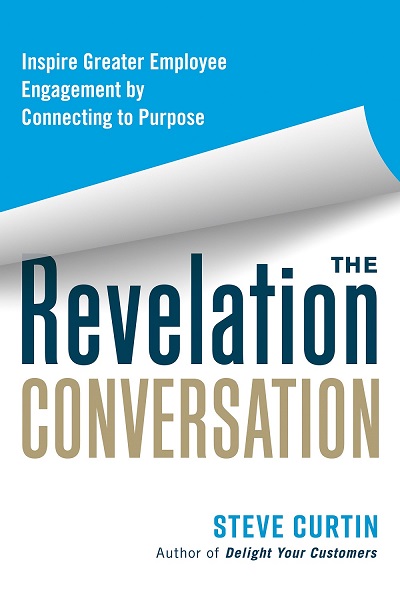
Enthuse Your People to Delight Customers with The Revelation Conversation.

Business leaders are happy because their customers are satisfied. But that’s not good enough. Customers feel that service is good, not better, just average. Nobody raves about average. And satisfied customers will leave once they find something better or less expensive. So don’t serve to sell to customers. And don’t serve to satisfy customers. Serve to delight them.

And just exactly how do you do that? In his book, The Revelation Conversation, Steve Curtin will tell you. But he doesn’t expect you to train your people.

Training is top down, one-way, “I know everything, you know nothing” instruction. Training is the how and what of customer service. Training is to develop THE BUSINESS. Training is for a job. And the job of employees is to serve to satisfy the customer. In the end, training instructs your people on how to TAKE CARE of the customer.

Instead, Steve is speaking with you as a coach, not at you as a trainer. He recommends that you educate your people. Your education is interactive and frequent, so much so, that you remind them every hour of every day. 

 Your education gives you the how, what, and WHY Of customer service. You not only give your employees job knowledge and skills, but also the PURPOSE of customer service. Your daily reminders will inspire your people to focus on the purpose of delivering exceptional customer service. Your education will develop YOUR PEOPLE. And the purpose of your employees is to serve to delight your customers. In the end, your people will CARE for your customers.

Reminding yourself and your people of Steve’s stories, examples, and encouragement, you will enthuse them to engage with customers. Your customers will be delighted and happy, intent on returning, raving to others.

Be sure to read The Revelation Conversation and take action to enthuse your employees to delight customers. And when you do, everyone’s lives will be enriched, literally and figuratively.

Leave a comment

Filed under Customer Service

Enroll Now in Customer CARE University.

We don’t offer customer service training. Training is top-down, one-way “I know everything, you know nothing” instruction. Training is the “how” of service. Training is to develop THE BUSINESS. Training is for a job. And the job of employees is to serve to satisfy the customer. In the end, training instructs students on how to TAKE CARE of the customer.

Instead, enroll in Customer CARE University. We don’t have trainers or instructors. We have mentors and coaches. Our education classes are interactive. Our education is the “how” and “why” of Customer CARE excellence. As mentors, we educate you with customer CARE actions to practice your interpersonal skills. You will learn and appreciate the value of telephone etiquette, service recovery, and customer CARE. After graduation, as coaches, we remind you of our customer CARE excellence strategies. With suggestions, recommendations, and encouragement, we empower you and your colleagues to develop YOURSELVES. Ideally, all of you will be enthused and energized to engage customers. You and your colleagues will create an emotional connection with your customers. The more emotional the connections, the more memorable the experiences, the more loyal the customers. And everyone’s lives will be enriched.

In Customer CARE 101, our passion is to CARE for you and your colleagues.

  • COMMUNICATE openly, transparently, interactively, and frequently any customer CARE information that you and your colleagues need or want to know. We will listen empathetically to your suggestions, concerns, and complaints.
  • APPRECIATE your role, responsibilities, and actions, and your suggestions and recommendations.
  • RECOGNIZE, honor, and offer accolades for you and your colleagues’ role-playing acts of customer CARE.
  • EMPOWER you to act on your own to do what is right for you, your colleagues, your customers, and your business.

In Customer CARE 102, we will educate you on how to CARE for your customers:

  • COMMUNICATE with every customer with a smile, eye contact, and polite interaction. Inform each customer transparently and interactively of the product’s or service’s function, liabilities, and advantages to the customer.
  • ACKNOWLEDGE each customer’s presence and value to you and your business.
  • RESPOND promptly and empathetically to each customer’s questions, concerns, and complaints.
  • ENRICH the experiences and, ultimately, the lives of every customer.

And, yes, we educate everyone. If we’re not caring for customer CARE representatives, we better be caring for your colleagues who are.

When we create a great experience for you as much as we do for your colleagues, you will earn the loyalty of both colleagues and customers. And soon, without your focus on profits, profits will grow, for you and your business, literally and figuratively.

Enrollment starts now. Tuition is free. But you must attend to learn each of the classes of the two courses or you will fail.

Enroll today. You won’t be sorry. And neither will your customers.

DISCLAIMER: Customer CARE University classes are my posts for either Customer CARE strategies for customer service people or Customer CARE actions for customers. You are always invited to “attend” the classes. Our discussions have been very interactive with open and honest opinions and complaints from some who have disagreed with me. With each interaction, I hope we can agree to disagree or agree. Whether you have the opportunity to “attend” regularly or can only “attend” when you can, I encourage you to remind yourself or your colleagues who interact with customers, when you say, “Let’s be GREAT out there!”

#customerservice #customerservicetraining #training #custserv

Leave a comment

Filed under Customer Service

Customers are paying for their experience, not your service.

Customers perceive service in their own unique, idiosyncratic, emotional, irrational, end-of-the-day, and totally human terms. Perception is all there is!” Tom Peters. Customers are paying for their experience. It’s ALL about them, NEVER about us. To them, perception is reality. Image is everything. Feelings are facts. And they buy with emotion and justify that decision with reason. 

Some customer service people will believe that customers will understand and be empathetic to the new employee. I get it. Customers will get it, too, but many are not going to like it. Customers are paying for THEIR experience. And they seek the best value in their experience, so, someone saying, “I’m in training” is, bluntly, a poor one. When someone new doesn’t say anything, the customer feels that the person must be knowledgeable and the problem is difficult. But that’s OK because the problem is the problem. But when someone says, “I’m new here,” that’s not OK, in fact, dissatisfying because the problem is not the problem. The problem is the person. They will leave and rant to others via social media. Customers thinking about coming to your company will decide otherwise because of his rants. It doesn’t have to be a customer they know. If you say you’re great, that’s advertising, but on social media, if they say you’re poor, that’s the truth. People are talking about you, whether you like it or not, whether you know it or not. You can give them a story that “We’re new here,” or be new here but not tell them. You decide.

The customer is paying for his experience, not your company’s service. Customers don’t care how many new people you have hired. They don’t care if self-service works for you or not. And customers don’t care if you think scripting will or will not work. What they care about is how big you care about them. New employees or not, self-service or not, scripting or not. To a complaining customer, you are not a representative of the company. You ARE the company. So own it. Be the CEO of the moment. DO take it personally. DO take it professionally. Just DON’T take it home. Simply apologize. DON’T offer an explanation. Customers feel that your explanation is an excuse. Customers want action, not excuses. Just do whatever it takes to fix it fast.

And when all alternatives don’t work, DON’T fire the customer. Simply ask him to resign. “I’m sorry but we aren’t able to resolve your problem. Could I recommend Brand X for your solution? I could contact them if you like.” Both are happy. And both will remember. The customer is happy because he has a  fix. He has an emotional connection with you. The more emotional the connection, the more memorable the experience, the more loyal the customer. And loyal customers will return.  Ideally, he will come back to you. The competitor is happy because you recommended them. Later when one of them cannot resolve the problem for the customer, they will recommend you. A Mutual Admiration Society of Sorts.

So you decide. Are you telling customers you are or have people who are in training? Or do you simply not say anything and do whatever it takes to fix the problem, even if it means going to a competitor? Whatever you decide, customers will decide, too.

3 Comments

Filed under Customer Service