English writer Samuel Johnson said, “People need to be reminded more often than they need to be instructed”. So, this week, I encourage you to remind yourself and your colleagues of this:
Customers pay for their experience, not your product or service. They buy with emotion and justify their decision with reason. Customers seek the best emotional value in their experience, not your logically reasonable best price, product, or service. When they complain, they don’t complain about the price. They complain about the value of their experience for the price that you’re asking them to pay. On the flip side, when customers seek the best value in their experience, they will pay, no matter the price.
QUI TAKEAWAY: It’s not about the good service you render. It’s about the GREAT experience your customers remember. Don’t just be good. Be GREAT out there!
QUI QUOTE: You know you have customer CARE right when your customers don’t tell others what they bought. They tell others who they bought it from. Don’t be just good. Be GREAT out there!
The “World’s Best” experience is not as “the world” sees it, but as one customer personally FEELS it.
Customers pay for their experience. And they seek the best value in their experience for the price you are asking them to pay. So, a person living in Detroit, MI who has a five-figure salary feels the best value isn’t a luxury plane to the Alps, but rather a four-hour drive UpNorth to Boyne Mountain. Instead of skiing through mountainous terrain for the week, sipping on Malbec wine from Argentina, and savoring Swiss cheese fondue, he skis up and down, again and again, on Boyne Mountain, every weekend day, gulping beer bottles of Milwaukee Light, and chomps on Wisconsin brats with his friends every weekend night. To him, that’s the World’s Best!
Once you understand the World’s Best experience for each customer, then you need to consistently deliver that experience to every customer with the Rule of Three QUI TAKEAWAYS to deliver the World’s Best customer experience. Why only three? Because nobody can remember Number Four.
Here are the three:
QUI TAKEAWAY: Customer service is what you do for your customers. Customer experience is how your customers feel before, during, and after what you do. Customer experience management is what you do before, during, and after discovering how customers feel about what you did. Customer loyalty is how your customers feel about what you proactively do repeatedly.
QUI TAKEAWAY: Customers pay for their experience, not your product or service. They buy with emotion and justify their decision with reason. Customers seek the best emotional value in their experience, not your logically reasonable best price, product, or service. When they complain, they don’t complain about the price. They complain about the value of their experience for the price that you’re asking them to pay. On the flip side, when customers seek the best value in their experience, they will pay, no matter the price.
QUI TAKEAWAY: The best emotional value in your customers’ experience is in your personalized interactions with them, not their business transactions with you. When it comes to customer loyalty, don’t get inside their heads. Get inside their hearts. Create an emotional connection. Don’t serve to satisfy your customers. Satisfied customers feel that their experience was good, not better, just average. Nobody raves about average. And satisfied customers will not return as soon as they find an experience that is better or a less expensive price.
Serve to WOW them! Serve to CARE.
COMMUNICATE with every customer with a smile, eye contact, and polite interaction. Inform each customer transparently and interactively of the product’s or service’s function, liabilities, and advantages to them.
ACKNOWLEDGE each customer’s presence and value to you and your business.
RESPOND promptly and empathetically to each customer’s questions, concerns, and complaints.
ENRICH the experiences and, ultimately, the lives of every customer.
The more emotional the connections, the more memorable the experiences, and the more loyal your customers are. Your loyal customers will return repeatedly, spend more money, and rave to others on social media.
When you understand the Rule of Three, don’t just think and talk about it. Do it! Don’t just serve to satisfy your customers. CARE for your customers and be GREAT out there! To them, that’s the World’s Best!
Corporate executives and CX influencers have traditionally advocated their business jargon, and their employees and customers have subserviently understood and followed them. For example, business leaders have defined contact centers when customers “contact” them to ask a question or have a problem with a product or service. The leaders then analyze their agents’ FCR metrics for First Contact Resolution.
Concurrently, business leaders and CX influencers dub customer service representatives as the frontline. But frontline? Really? They may logically say that customer service is the frontline because they are front and center with customers. However, as customers, we emotionally feel we are doing battle with the customer service frontline.
Well, no more. As customers, NOW is the time for our customer CARE Revolution!
We pay for our experience, not your product or service. And we pay for our entire experience, not yours. It’s ALL about us, NEVER about you. We seek the best emotional value in our entire experience, not the minutiae of your logically reasonable best prices, products, or services of yours. For instance, when we have a problem or complaint, the best emotional value for us is not a first-contact response with contact center agents. The best value in our experience is in the agents’ personalized interactions, not their business transactions.
While business leaders are happy because their customers are satisfied with the purchase of their product or service, that’s not good enough for us. Satisfied customers feel that their experience is good, not better, just average. Nobody raves about average. And satisfied customers will not return as soon as they find a better experience or a less expensive price.
Accordingly, contact centers and businesses must do better.
Doctors and nurses don’t serve their ailing patients. They care. So shouldn’t customer service be customer care? Even better, as customers, we deem contact center and customer service representatives to be the customer CARE team. Their service mantra should be:
“We CARE for each customer:
COMMUNICATE with polite interaction. We inform each customer with transparency of the product’s or service’s function, liabilities, and advantages. Listen to understand the customer’s questions.
ACKNOWLEDGE each customer’s presence and value.
RESPOND empathetically to each customer’s concerns, and complaints.
ENRICH the experiences and lives of every customer.
When we CARE, each customer has an emotional connection. The more emotional the connections, the more memorable the moments, and the more loyal our customers are. Our loyal customers are WOWED and happy, intent on returning, and raving to others on social media.”
So, as customers, let’s be revolutionary in improving our customer experience with Customer CARE. NOW is our time! Let’s be loud and proud! Let’s be revolutionary! And let’s have our experience be GREAT out there!
The customer is not always right. But the customer is ALWAYS YOUR customer. Listen intently, respond empathetically, apologize, and do whatever it takes to resolve the problem, even if it means having to go with your customer to your competitor.
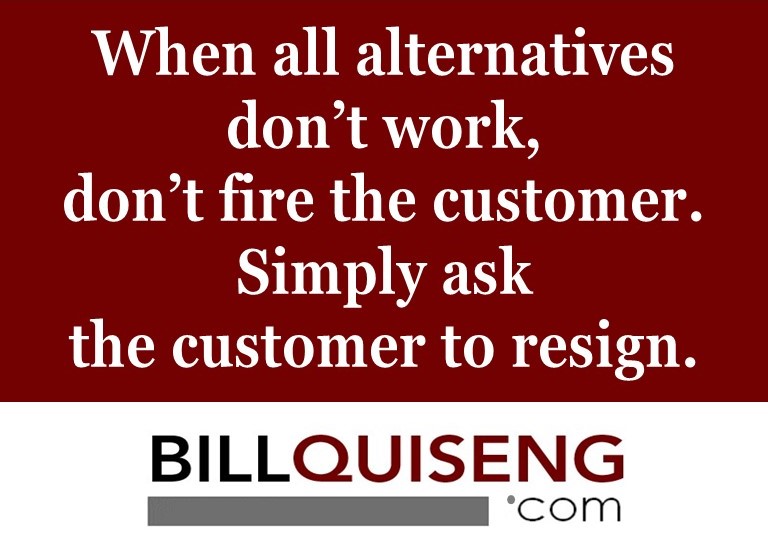
Contrary to popular customer service mantras, when all alternatives don’t work, DON’T fire the customer. Simply ask him to resign. “I’m sorry but I’m not able to resolve your problems. Could I recommend Company X for your experience? I could contact them if you like.” Both the customer and your competitor are happy. The customer will remember you and might be loyal to you. The competitor is happy because you recommended them. They may refer you later when they cannot resolve another customer’s complaint. A Mutual Admiration Society of sorts.
From me to you, from one customer service advocate to another, Happy Valentine’s Day. For having read my blog, I very much appreciate you. On this special day, I wish each of you the very best, but I already know you’re one of the very best. So, I wish you GREAT happiness, kindness, enthusiasm, and success.
Today, let’s appreciate each other and show our love for all business professionals. When we express our appreciation to each other and our fellow business professionals and customers, let’s not be just good. Let’s be GREAT out there!
English writer Samuel Johnson said, “People need to be reminded more often than they need to be instructed”. So, as you prepare yourself every morning to engage and WOW your colleagues and customers, I encourage you to look in the mirror and remind yourself, “Don’t be just good. Be GREAT out there!
Welcome to CX 101. Today’s course is a prerequisite for business professionals in the B2C or hospitality industry. It’s an elective for the B2B or the online/digital industry.
This is not a customer service training class. Training is finite, usually one to three days. And training is top-down, one-way “I know everything, you know nothing” instruction. Training is to develop THE BUSINESS. Training is for a job. And the job of employees is to serve to satisfy the customer.
Instead, our education classes are interactive. With suggestions, recommendations, and encouragement, we empower you and your colleagues to develop YOURSELVES. Ideally, all of you will be enthused and energized to engage customers, not just to satisfy, but to WOW them.
So let’s get started.
Customer service is what you do for your customers. Customer experience is how your customers feel before, during, and after what you do. Customer experience management is what you do before, during, and after you find out how customers feel about what you did. Customer loyalty is how your customers feel about what you did repeatedly.
Customers pay for their experience, not your product or service. And it’s THEIR experience, not yours. They buy with emotion and justify their decision with reason. Customers seek the best emotional value in their entire experience, not the minutiae of your best price, product, or service, virtual or physical locations, AI, online, chatGPT, or face-to-face customer support, NPS, CSAT or other CX metric, or the many other details of your business experience.
You are happy because your customers are satisfied with their experience. You met their expectations. But that’s not good enough. Satisfied customers feel that their experience is good, not better, just average. Nobody raves about average. And satisfied customers will not return as soon as they find a better experience or a less expensive price. So you have to do more than satisfy your customers. Don’t just serve to sell to customers. And don’t serve to satisfy customers. Serve to WOW them.
Next week’s class is postponed until Valentine’s Day.
So the next class two weeks from now: How to serve to WOW your customers.
Before next week’s class, are there any questions? Whether you agree or agree to disagree, discuss or not, I’m sure that we can interact with each other without being disagreeable. So, I invite you to share your questions and comments.
English writer Samuel Johnson said, “People need to be reminded more often than they need to be instructed.” So as you prepare yourself every morning to engage to WOW your customers, I encourage you to remind yourself when you say, “Don’t be just good. Be GREAT out there!
English writer Samuel Johnson said, “People need to be reminded more often than they need to be instructed”. So I encourage you to remind yourself and your colleagues every day about each one of these reminders I published in 2023:
25 QUI QUOTE Reminders about Customers and Customer Service.
You can either repeat these QUI QUOTES or remind yourself, your customer CARE team, or your leadership colleagues about these QUI QUOTES which are collectively published this month in 2024.
ASSETS
Your most important assets are not your customers and your people. It’s how your customers and your people feel about you and your company.
CEO OF THE MOMENT
To a complaining customer, you are not a representative of the company. You ARE the company. So, own it. Be the CEO of the moment. Take it personally. Take it professionally. Take it responsibly. Just don’t take it at home.
COMMON SENSE
Delivering GREAT customer service is business common sense. Your job is to make it common practice.
COMPLAINT
A customer complaint is a gift. Take the perspective that customers complain because they want to help your business. Otherwise, they would walk away, saying nothing, with no intention of ever returning.
CONDUIT
Your relationship with your customers, not their purchase of your product, is the conduit where true value flows.
CSAT CX METRICS
Your customers don’t care about your NPS, CSAT, or CX metrics. They only care about theirs: One to One. Human to Human. Heart to Heart. The value to your customers is in their personal interactions, not your “cash or credit” business transactions. To earn customer loyalty, don’t get inside their heads. Get inside their hearts. Create an emotional connection. Think RELATIONSHIPS or Go Broke. Literally.
CUSTOMER
A customer is a person. Not a dollar, Not a satisfaction score. Not an online review. Customers are people. CARE BIG for them.
CUSTOMERS BOUGHT
You know you have customer CARE right when your customers don’t tell others what they bought. They tell others who they bought it from.
DISSATISFY ME
No customer, intent on paying, has ever entered your store to loudly proclaim, “Here I am. Dissatisfy me now!”
No employee, intent on working, has ever started their first day by loudly proclaiming, “Here I am. Dissatisfy me now.” If all you do is lead with top-down, one-way, communication, your employees will soon be disillusioned and disengaged, only working because they HAVE TO. But if you have a servant leadership mindset to CARE for your employees, your people will feel respected, appreciated, and valued. They will loyally return, be more productive, and rave to others on social media.
EXPERIENCE TRUMPS
Your customer’s negative experience of your service trumps your advertising every time.
EXPLANATION EXCUSE
Listen to their complaints with the intent to take action, not to explain. To a customer, when something is wrong, your explanation is an excuse. Customers want action, not excuses.
FINE
When you ask customers “How is everything?” and they respond, “Fine,” just know you “Failed In Nailing Expectations.”
HABIT
If you want your people to make it a habit to deliver outstanding customer CARE, you have to make it a habit to recognize them when they do.
INNOVATION
We need to future-proof the customer experience. We analyze the journey to ask, “What are the potential dissatisfiers and how can we remove them?”, and when we ask and take action, a negative customer experience has turned into a neutral one. But that’s not good enough. Satisfied customers feel their experience is good, not better, just average. Nobody raves about average. And satisfied customers will leave when they find an experience that is better or a less expensive price.
So don’t serve to satisfy customers. Don’t treat customers as they would have expected. Don’t treat them as they want to be treated. And don’t treat them as YOU want to be treated. Instead, treat them a little better than they want to be treated. Serve to WOW them.
Future-proof the customer experience. In addition to asking “What happened?” to your people answering customer complaints, ask them “What if?” Exceeding the expectations of current customer needs and innovating future potential customer wants will maximize the ROI of CX. So, always be asking, “What happened?” and “What if?” Always be innovating. And always be GREAT out there!
KEEP FIND
Work as hard to keep customers as much as you do to find them.
MARKETING
Marketing is not your advertising online to customers. It’s your customers raving to others on social media about your customer CARE. To them, you’re not just good. You are GREAT out there!
METRICS
Your customers don’t care about your NPS, CSAT, or CX metrics. They only care about theirs: One to One. Human to Human. Heart to Heart.
NOBODY
Nobody raves about a company that meets customer expectations.
Nobody raves about average.
OVERPROMISE
Overpromise and underdeliver and you’re sure to lose a customer’s trust. Don’t make it right and you’re sure to lose a customer.
PERCEPTION
Your customer’s perception of your customer service trumps your advertising
PERFECT PRACTICE
The most valuable thing you can make is a mistake. But you CAN learn something by being perfect … for your customers. When it comes to business, the customer’s value in their experience is just “perfect.” Practice does not make perfect. Perfect practice makes perfect … for your customers.
PERSPECTIVE
Take the perspective that the customer complains because he wants to help your business. Otherwise, he simply would have left, saying nothing, intent on never coming back.
POLICY
If you’re making frequent policy exceptions, then customer perception does not match company promises. It’s poor policy. Fix it.
PRICE VALUE
When customers complain, they don’t complain about the price. They complain about the value of their experience for the price that you’re asking them to pay. On the flipside, customers will pay for their best experience, no matter the price.
RELATIONSHIP
The value to your customers is in their personal interactions, not your “cash or credit” business transactions.
Your relationship with your customers, not their purchase of your product, is the conduit where true customer experience value flows.
SERVE WOW CARE
Don’t serve to satisfy customers.
Don’t treat customers as they expect to be treated. And don’t treat them as you want to be treated. Instead, treat them a little better than they want to be treated. Serve to WOW them. Serve to CARE.
COMMUNICATE with each customer with a smile, eye contact, and polite interaction. Inform each customer transparently and interactively of the product’s or service’s function, liabilities, and advantages to them.
ACKNOWLEDGE each customer’s presence and value to you and your company.
RESPOND promptly and empathetically to each customer’s questions, concerns, and complaints.
ENRICH the experiences and, ultimately, the lives of every customer.
When you CARE, each customer is WOWED and happy, intent on returning repeatedly, spending more money, and raving to others on social media.
VALUE
As their leader, the value to your people is in their personal interactions with you, not your business transactions with them.
VENT
Listen and allow complaining customers to vent. Angry or frustrated customers generally will not listen or accept your apology until they have an opportunity to voice their frustrations.
WORLD’S BEST
The “World’s Best” customer experience is not as the world sees it. The “World’s Best” Is how one customer FEELS it.
Every morning, when you prepare yourself or your customer CARE people to engage and WOW your customers, I encourage you to remind yourself or your customer CARE people during your daily briefing by reciting one of your favorite QUI QUOTES and, in the end, saying, “Don’t be just good. Be GREAT out there!”
Three weeks ago, I introduced the Rule of Three QUI TAKEAWAYS which will be revolutionary now, but once discussed many times over, will be viewed as traditional by many business professionals. In the last two weeks, I explained the first and second QUI TAKEAWAYS: CX versus CXM, and customer service versus customer CARE. In the next week, join me as we revolutionize the CX experience. This week, I will explain the third QUI TAKEAWAY: customer service training versus customer CARE education.
QUI TAKEAWAY: Don’t offer customer service training. Training is finite, usually one to three days. And training is top-down, one-way “I know everything, you know nothing” instruction. Training is to develop THE BUSINESS. Training is for a job. And the job of employees is to serve to satisfy the customer. In the end, training instructs people on how to TAKE CARE of the customer.
Instead, have business people enroll in Customer CARE University. We don’t have trainers or instructors. We have mentors and coaches. Our education classes are interactive. As mentors, educate your people with customer CARE actions to practice their interpersonal skills. They will learn and appreciate the value of telephone etiquette, service recovery, and customer CARE. After graduation, as coaches, remind them of your customer CARE excellence strategies. With suggestions, recommendations, and encouragement, empower your people to develop THEMSELVES and engage customers. Your people will create an emotional connection with their customers. The more emotional the connections, the more memorable the experiences, the more loyal the customers. Loyal customers will repeatedly return, spend more money, and rave about their WOW experience to others on social media.
In Customer CARE 101, your passion is to CARE for your people.
COMMUNICATE openly, transparently, interactively, and frequently any customer CARE information your people need or want to know. Listen empathetically to their suggestions, concerns, and complaints.
APPRECIATE their roles, responsibilities, actions, suggestions, and recommendations.
RECOGNIZE, honor, and offer accolades for their role-playing acts of customer CARE.
EMPOWER your people to act on their own to do what is right for them, their colleagues, their customers, and your business.
In Customer CARE 102, educate your people on how to CARE for their customers:
COMMUNICATE with each customer with a smile, eye contact, and polite interaction. Inform each customer transparently and interactively of the product’s or service’s function, liabilities, and advantages to the customer.
ACKNOWLEDGE each customer’s presence and value to the customer CARE person and your business.
RESPOND promptly and empathetically to each customer’s questions, concerns, and complaints.
ENRICH the experiences and, ultimately, the lives of every customer.
And, yes, educate everyone. Don’t just educate customer CARE representatives. Educate the people in the business who don’t need to CARE for their customers. When you create a GREAT experience for everyone as much as customer CARE representatives need to with their customers, you will earn the loyalty of both. Soon, without a focus on profits, profits will grow. Everyone, the people, their customers, the leaders and their businesses, and you and your business, will be enriched.
NEXT WEEK: Now is the time for a CX Revolution! Part Four.
For several weeks, starting last October, I offer each one of the Rule of Three QUI Takeaways to revolutionize CX. Why only three? Because nobody can remember Number Four. Who is the first President of the United States? Surely, George Washington. Who is Number Four? Who is the first person to walk on the moon? Neil Armstrong, of course. Who is Number Four? (By the way, the answers to who is Number Four are James Madison and Alan Bean.)
With the Rule of Three in mind, here is the second QUI TAKEAWAY: Customer service versus customer CARE.
Doctors and nurses don’t serve their ailing patients. They care. So shouldn’t customer service be customer care?
At the same time, customer service experts have advocated that the the people in customer service are the frontlines. Really? We may logically say that customer service representatives are the frontlines because they are front and center with customers. But customers emotionally feel they are doing battle with the customer service frontlines. So, no more saying that customer service representatives are the frontlines.
Business leaders are happy because their customer service people serve to satisfy their customers. But that’s not good enough. Satisfied customers feel that their experience is good, not better, just average. Nobody raves about average. And satisfied customers will not return as soon as they find an experience that is better or a price that is less expensive.
We have to do better than serve to sell to our customers. And we need to do better than to serve to satisfy our customers. Don’t treat customers as they expect to be treated. And don’t treat customers as YOU expect to be treated. Instead, treat your customers a little better than they expect to be treated. Serve to delight and WOW them. Serve to CARE for your customers.
COMMUNICATE with every customer with a smile, eye contact, and polite interaction. Inform each customer transparently and interactively of the product’s or service’s function, liabilities, and advantages to them.
ACKNOWLEDGE each customer’s presence and value to you and your business.
RESPOND promptly and empathetically to each customer’s questions, concerns, and complaints.
ENRICH the experiences and, ultimately, the lives of every customer.
And be Magnificently Boring to CARE! Consistently CARE for your customers so repetitively that you feel it is boring, but to every customer, at that moment, you are Magnificent! Customers have an emotional connection with you. The more emotional the connections, the more memorable the experiences, and the more loyal the customers are. Loyal customers will return repeatedly, spend more money, and rave about you to others on social media. Consistency builds trust. Trust builds relationships. Relationships build loyalty. Loyalty builds your business. CARE Magnificently!
Serving customers because you HAVE TO is your job. But giving GREAT customer CARE because you WANT TO is your passion. Customer CARE is having the liberty to determine one’s own actions, in this case, not to satisfy them, but to actualize their happiness. Service is satisfying your customers because you have to please them. Instead, make your customers happy because you want to please them. Emotionally bond with customers when you are interacting with them. Don’t take care of your customers because you have to. CARE for your customers because you want to.
Do more than satisfy your customers. Personalize your interaction to emotionally bond them to you. Then make them happy. Good customer service is having a smile on your face. GREAT customer CARE is having a smile on your customers’ faces.
When it comes to customers and customer CARE, don’t just be good. Be GREAT out there!
Next week: The third QUI TAKEAWAY: Customer service training versus customer CARE education.
"People need to be reminded more often than they need to be instructed."
Samuel Johnson
This blog, along with my Facebook, Instagram and Twitter pages, offer practical tips, insight and inspiration to serve as reminders on how to improve your personal delivery of customer service.




















 BILL QUISENG | Deliver the World's Best Customer Experience