Category Archives: Customer Service

Nick Meiers: Using Kano Analysis to improve guest satisfaction

If you have ever heard me speak about customer service, you know that I believe you should CASE (Copy and Steal (or save) Everything) from your competitors or from a business in another industry to find some idea that you can incorporate into your business to Deliver the World’s Best Customer Experience.

Having had a 30 year career in luxury resorts and hotels, I feel that the hospitality industry can offer strategies that can help B2C businesses improve their delivery of customer service. To that end, this guest post is written by Nick Meiers. Nick writes about leadership, team development, and service excellence in the hospitality industry at his blog, Essential Hospitality. For other customer experience CASE ideas from hospitality, be sure to follow Nick on Twitter @HospLeader.

In this post, Nick explains how the Kano Analysis method can create an exceptional guest/customer experience. 

The expectations, requirements, and demands of our guests don’t all carry the same weight; they’re quite different from each other. Leaders must realize that:

  • There are some things demanded by guests that they will not go without.
  • The quality of some elements will either make or break the guest experience.
  • Guests want a lot of things they don’t even know they want.
  • Some of what you do doesn’t impact the average guest at all.

Confusing these different attributes of the guest experience can lead to:

  • Eliminating the wrong things from the guest experience.
  • Spending too much money on things that don’t matter to guests.
  • Failing to differentiate one’s operation from that of a competitor.

This is a long post, but I’m going to show you how we can sort out guest demands and prioritize appropriately. This is a process, and if you skip to the end none of it will make any sense.

Kano Analysis is a tool used to determine which attributes of a product or service are most important to guests. Knowing which are most important will allow you to prioritize improvement efforts that will result in greater guest satisfaction.

Imagine you’re looking for ways to examine what is important to guests at your resort, specifically in your casual, full-service, tropical-themed restaurant.

First, let’s look at the five attributes of customer satisfaction. You need to understand these to apply the tool.

Understanding different attributes of guest requirements

“Must-Bes”

These are the basic requirements of your guests. You don’t get bonus points for having them, but you don’t have a chance without them. When was the last time a guest at your restaurant said, “Finally, a restaurant with chairs!” Of course you have chairs. Adding more tables to the restaurant wouldn’t make the experience any better if the kitchen can’t support them. Getting tables made out of the world’s most expensive wood wouldn’t provide an appreciable increase in guest satisfaction. Some things, you just need to have.

Other Must-Be (without these at a restaurant, you’re dead): Food, waitstaff, utensils, plates

“Satisfiers”

The more satisfiers you have, the better. Customers generally demand satisfiers—they’ll eat a restaurant with more satisfiers. If your food is good that’s great…if it’s reasonably priced that’s even better. If your waitress is friendly that’s great…if she knows the menu and makes good recommendation and tells some jokes that make your family laugh, all the better. But, it goes both ways. If your food is bland and expensive, and the waitress is boring then your guests will be less satisfied.

Other Satisfiers (make sure you’re doing a good job on these things): wait time, ambiance, comfort, pace of meal, accuracy in preparation, food temperature, proper use of music

“Exciters”

These are the unexpected surprises that meet your guests’ unspoken desires and make their experience great. Imagine you put little umbrellas in the drinks or deliver a birthday cupcake upon overhearing that the family is celebrating Dad’s birthday. The family didn’t ask for a celebratory cupcake—but they did (indirectly) ask for a good time—and you surpassed their expectation. Note that the absence of exciters doesn’t decrease guest satisfaction, since they weren’t expecting anything anyway.

Other Exciters (sprinkle these in and satisfaction improves): anything unexpected that meets a guest’s unspoken desires

“Indifference”

The indifferent elements are those that don’t directly influence your guest’s satisfaction or their decision to do business with you. For example, your guests don’t care about the brand of quarry tile in the kitchen; it doesn’t impact their experience in the slightest. Frankly, they wouldn’t care if you were cooking on a gravel floor.

“Reversers”
These are the extra processes that your guests don’t like. Obviously, you want to keep these to a minimum.

(And remember— Exciters evolve into Satisfiers and Satisfiers evolve into Dissatisfiers. Paying by credit card was once an Exciter—a novelty. It became a Satisfier and is now a Must-Be, especially for the younger generation, as you know if your restaurant doesn’t accept credit cards.)

Now that you understand these different attributes, let’s consider how we would design a customer service survey to determine into which categories guests would place certain aspects of their experience. You may think you know what your guests think, but you want to be sure.

(Note: The Kano Analysis process is complex and out of the scope of this blog; we’re going to look at this on a basic, practical level.)

What do MY guests think are Must-Bes, Satisfiers, and Delighters?

Good question! You might not know if something is a Must-Be, Satisfier, or Delighter. This is where surveys come in handy.

Imagine your jungle-themed restaurant has jungle-themed live music every night. You’re wondering if this is worthwhile. When designing your survey, you’ll ask the question in the functional (positive) form and the dysfunctional (negative) form:

1.) How do you feel when live musicians are performing during dinner at our restaurant?
a) I like it.
b) I expect it.
c) I don’t care.
d) I don’t like it.

1.) How do you feel when live musicians are not performing during dinner at our restaurant?
e) I like it.
f) I expect it.
g) I don’t care.
h) I don’t like it.

You’ll use this chart to see what your guests’ answers mean. I’ll tell you how to read it below.

Negative Question
How do you feel when live musicians are not performing during dinner at our restaurant?

Positive Question
How do you feel when live musicians are performing during dinner at our restaurant?

Like it

Expect it

Don’t care

Dislike it

Like it

?

Exciter

Exciter

Satisfier

Expect it

Reverse

Indifferent

Indifferent

Must-Be

Don’t care

Reverse

Indifferent

Indifferent

Must-Be

Dislike it

Reverse

Reverse

Reverse

?

What can we learn using this table? Let’s suppose that guests responded that they expect to have live music and they dislike it when it’s not there. What would you call this? (Look at the chart). It’s a Must-Be. What if guests responded that they like it when the musicians are performing, but they don’t care when there is not live music. This points to an Exciter. In a large-scale survey, you’d setup a table like this and see where most of the results fell. You can even separate the data by age, sex, or other demographics. Certainly, everybody doesn’t see things the same way.

What do I do with these categories?

Great, you understand your guests’ preferences. What’s next? You might start by making a chart that divides elements of the guest experience into their categories. For example:

Element

Requirement Type

Silverware

Must-Be

Live music on evenings

Delighter

Great waitstaff

Satisfier

Clean dining room

Must-Be

Of course, the list would continue…

Now it’s time to design a Voice of the Customer survey that will show how you’ve been doing on these things. Questions would be in the format:

How was the cleanliness of the dining room?
a.) Very Good
b.) Good
c.) Neutral
d.) Poor
e.) Very Poor

If the data were to show that guests are not happy with your dining room’s cleanliness and you know cleanliness is a Must-Be, you’ve identified an area where you might be losing market share. Improving this won’t dramatically grow your business, but it’ll keep you from losing ground. If your waitstaff aren’t friendly, you will know that investing more resources in training your staff will result in increased guest satisfaction, since this is a Satisfier.

That’s a start. I hope you now have a better understanding of this powerful tool, or at least a new way to see what your guests are really thinking.

5 Comments

Filed under Customer Service

Micah Solomon: Why don’t the old ways work in business and customer service anymore?

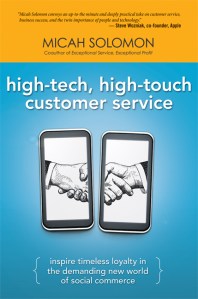
This is a guest post written by Micah Solomon, a customer service and marketing speaker, strategist, and author of the new book, High-Tech, High-Touch Customer Service.

Find Micah at http://www.micahsolomon.com or visit his blog: http://www.collegeofthecustomer.com

 
“Why don’t the old ways work with customers anymore?” … I hear this question frequently when I’m speaking at a business event or starting a new  customer service consulting engagement.

First off: in certain, important ways, the old ways do still work.  Let me explain. What makes you great at social media and online customer service are very often the same skills that made you great before Facebook (sorry:  TheFacebook) was even invented. In other words, social media is a dramatic amplifier of the positive, and of the negative—and if what you do for customers in your business is positive enough (great product, great problem resolution process, consideration of the emotional aspect of every interaction with your customers), the word can get out on a much bigger scale than ever before.

But the context of our work has undeniably changed, because of the recent changes that have swept through the world of commerce. Changes of which social media is only one. Since the advent of the internet, and, most specifically, the broad use of the Web starting in the mid-1990s, there’s been a dramatic transformation of the competitive landscape. The changes brought on by these new communication and distribution channels are in many ways revolutionary, and they’re causing disruptions akin to those of past revolutions.

For example, our sense of timeliness: What was plenty fast this time last year feels draggy now to the very same customers because of changing expectations brought by mobile technology, social media–induced restlessness, the incredible efficiency of vendors like Amazon.com, and other factors.

For a parallel, look at the changes of the mid-nineteenth century. During this period the stability of rural and village life was thrown into disarray due to a host of technological advances, including those making it possible to preserve and transport food. Customers could now purchase edibles from across the country or around the world: The farmer in New England who had been able to count on a captive local market for whatever would graze or grow in his stony fields was now competing against topsoil-rich Illinois and lamb-friendly New Zealand. The result was a mass abandonment of farms throughout the region.

The transformation was striking: Go for a walk in the woods of New Hampshire or Vermont and you’ll still see the proliferation of old stone walls and foundations that attest to the abandoned farms and homesteads of this era.

Or just remember your high school poetry. This New England exodus is the backstory of Robert Frost’s stuck-in-his-ways neighbor still trying to mend a fence: He doesn’t realize times have changed and the fence, at most, is now preventing runaway trees. There are no cattle to contain anymore.

You can’t afford to be similarly left behind by today’s transformational technologies. It’s crucial to invest brain cells, time, and money to keep up with what it takes to hold on to your customers, now that we’re all playing on a global, digitally connected field.

Leave a comment

Filed under Customer Service

John-Paul Narowski: Don’t settle for the “Customer Service Checklist” – Buy in to the philosophy

This is a guest post written by John-Paul Narowski, founder of karmaCRM. Find out more about John-Paul and his company at the end of the post.

Recently I purchased a book from the local bookstore.

On the way in, I got a friendly “Hi, can I help you find anything?” from a passing employee. I asked where I could find small business books, and she gave me quick directions to the right spot. Perfect. I smiled.

As I approached the checkout counter with the book in one hand and my wallet in the other, the cashier greeted me with a warm smile and a friendly “Hello, I can help you right over here. How are you today?” As I handed over my credit card, the cashier even took note of my name. “Thank you, John. Would you like to sign up for our rewards program?” I smiled again. The service so far was outstanding – it made me feel like my business was truly appreciated.

I normally avoid rewards programs because I don’t like having all of the extra cards in my wallet. But on that day, the service I’d received put me in a great mood. I said yes. Not only did I say yes, but I also imagined returning to the store for my next book and using my loyalty card. After all, this local store was right down the street and everyone was so friendly.

But when I agreed to take the loyalty card, the happy customer service facade came down. It was as if the switch had been flipped off. The cashier (Claire was her name) stopped smiling immediately, and started typing on her computer, presumably bringing up the page where she could enroll me in the rewards program. Then Claire, the very same cashier who smiled, thanked me by name, and asked about my day, scrunched up her eyebrows. She gave me a puzzled look and asked, “what was your name again?”

I’m sure many of you have experienced something similar. It doesn’t take a genius to realize that Claire had been trained to follow a standard “customer service checklist” – one of those 3 step magic bullet systems designed to, in this case, get me to sign up for the rewards program. Smile, say thank you, read the name off of the card, and ask to join. I’m not the only customer that can see right through that – especially when it becomes obvious that the employee wasn’t really listening.

Let it be known – customer service is not a checklist. It’s a philosophy. Each customer deserves special treatment. Checklists don’t make anyone feel special. They just reinforce the fact that we are all treated the same. Checklists are what I like to call “doing the minimum.”

To Claire, forgetting my name was no big deal. To me, Claire represented the local bookstore. As Bill is fond of saying, “To the customer, YOU are the company.” When she forgot my name after her canned 3-step loyalty card checklist, it made a big difference. It was as though the bookstore had already forgotten about me, my money, and my choice to support their local business.

As a small business owner myself, customer service is one of my passions. After all, the customers pay for the employees, the store, the product, the lights, the counter, and everything else. But here’s the kicker. The customers aren’t thinking about all of that. They pay for their experience, not yours.

So why shouldn’t we focus on customer experience? I call this business philosophy customer-centricity. I’ve made it the focus of my entire business. Every decision I make, from hiring and training employees to refining my product, is designed to provide the customer with a better experience.

Next time you catch yourself or your employees following a checklist, ask yourself if the customer feels special. Then do something extra and see if it makes a difference. Grow out of relying on the checklist. Put in that extra effort to make the customer feel special. Trust me – the customer does care, and they are paying attention.

John-Paul Narowski is a customer-centric thought leader and founder of the Ann Arbor, MI-based karmaCRM, a small business software solution designed to help manage sales teams and build strong relationships with customers.

John-Paul, or JP as his friends call him, is fanatical about customer service and the customer-centric business model. Improving customer relationships is his passion and his business. Every decision JP makes at his company, from hiring employees to developing new features for his software, is based upon improving the customer experience.

 JP was recently interviewed by fellow customer service expert, Shep Hyken, where he discussed further his customer-centric philosophy. You can read that post hereFind out more about JP and karma at http://www.karmacrm.com. You can also follow karmaCRM on Twitter

Leave a comment

Filed under Customer Experience, Customer Loyalty, Customer Service, Training

Don’t expect C-level execs to fix their company’s customer service

Often after one of my presentations, an attendee will approach me to tell me of a terrible customer experience with one of the big brands.  They ask me, “If they say that customer service is so important, then why is it so bad? Corporations are people, too. And if they are people, then aren’t they customers at some point? Don’t they experience what we experience? Don’t they get it?”

I respond to them by saying that no matter how much those companies say they value customer feedback, don’t expect their delivery of customer service to get better any time soon. While C-level executives must be customers and experience service for themselves, they experience it like they do in the first-class section flying on a plane. Since they are not personally paying for the ticket, they do not worry about getting their money’s worth. They do not weigh the experience with the expense to assess value like we do. Going to the front of the line and with ample leg room and access to whatever their needs might want, they are blind to what we real customers must endure behind that first-class curtain. As we complain about cramped leg room and rising baggage fees, they simply do not hear any of it through their noise-canceling headphones.

When they are back in the office, they do what they were hired to do which is to maximize profits. While executives have a base pay we would envy, they are moved to maximize profits to earn their incentive pay of bonuses and stocks. And if sales are flat because customers can’t afford to spend much, then to protect their profit margins, executives dictate layoff and other cost-cutting measures, oblivious to its impact on the customer experience. To them, customer-centricity measures do not quantify with an ROI on a profit statement. So I understand why they do what they do. I understand it. That doesn’t mean I agree with it.

Unfortunately, customers don’t hire the people who serve them. Companies do. And companies, led by those executives, don’t care. The fish stinks from the head down, but the head does not know it’s stinking.

I believe the real question is “How does a customer service representative who wants to give exceptional service survive in a company that doesn’t care?”

QUI ACTION STEPS:

If you are one of those C-level executives: Don’t wait for Undercover Boss to call. Make it a part of your daily leadership regimen to get out of the office to find out what is really going on in your operation. You can’t build the business without sales. And you can’t build sales without satisfied customers. If you don’t know what’s going on, one employee could kill your business and you won’t even know it when it happens. I can tell you that every C-level executive who has been spotlighted on Undercover Boss finds out that the company isn’t performing as well as he/she thought it was. I can also tell you that any viewer of Undercover Boss who is an employee in any company can tell you that they saw it coming.

If you are an employee: Theodore Roosevelt said, “Success, the real success, does not depend upon the position you hold but upon how you carry yourself in that position.” You do not need a CEO title to act like a leader. Know this: At the moment that the customer is interacting with you, you have as much ability to build customer loyalty as your CEO. Make the difference for your customer. Your goal: When the customer walks away from you, he says to himself, “Wow! That person really cared about me.”

4 Comments

Filed under Customer Service

Six Major Customer Trends from Customer Service author and speaker Micah Solomon

Learning to treat individual customers as individuals is a key to business success. But being aware of underlying trends in the marketplace is also essential for the success of any business that relies on significant numbers of transactions and forward-looking planning. Here are six major customer trends I identify in my new book, High-Tech, High-Touch Customer ServiceContinue reading

Leave a comment

Filed under Customer Service

Viral Wisdom by James Lawther

In a minute I will turn over this post to James Lawther, this month’s guest blogger. But first an introduction.

Charlie “Tremendous” Jones said, “You’ll be the same in five years as you are today, except for the people you meet and the books you read.” And one of my professional development mantras is “Commit to lifelong learning.” The internet and social media gives us all the opportunity continue learning from others, meeting new people on-line to stimulate and continue a discussion about topics that are important to us. I enjoy reading and exchanging views about customer service, leadership and operational excellence. In that pursuit, I connected with James via Twitter and subscribed to his blog immediately after reading his bio:

James Lawther is a middle aged middle manager.

 To reach this highly elevated position he has worked for numerous organisations, from supermarkets to tax collectors and has had several operational roles including running the night shift for a frozen pea packing factory and doing operational research for a credit card company.

 As you can see from his CV he has either a wealth of experience, or is incapable of holding down a job. If the latter is true this post isn’t worth a minute of your attention.

 Unfortunately, the only way to find out is to read it and decide for yourself.

You’ve got to agree that someone with that kind of broad professional experience and sense of humor about it is well worth following. Since subscribing, we have exchanged comments on each other’s blogs and via Twitter  and I have really enjoyed the dialog. If you are intent in driving continuous improvement for your business, I’d recommend learning from James by visiting his website.

So, without further ado, James Lawther:

Today I am going to infect you with some viral wisdom.

If you haven’t been struck down yet, viral wisdom is the plague of the 21st century.  Victims suffer with assorted symptoms including lost time, vague fleeting thoughts and exasperated looks from their husbands.  The infection passes from friend to friend via the links they post on facebook, and the e-mails they send.  The wise realise that the most contaminated place in the world is the twitter stream sitting on their very own iphone.

The most contagious strain of viral wisdom cloaks itself cunningly.  It appears to be very sensible, creates a palpable “a-ha” moment in the mind of the reader, is a little bit (but not too) clever and compels you to read on because you never know, it could be really informative (unlikely, but possible).

The first piece of viral wisdom I have for you came from my twitter stream:

Modern Art = I could do that + Yeah but you Didn’t

It is hard to be wise in 140 characters but I’m sure you can take some meaning from that, did you feel the “a-ha”?

The second piece of wisdom came form an e-mail a friend sent me.  It was an interview with Will Smith.

Before I share it, I need to set the record straight, I like Will Smith, I used to watch the Fresh Prince of Bel-Air avidly and Men in Black has to be one of the world’s greatest movies, (well the eight foot tall cockroach was worth seeing) but let’s be honest, Mr. Smith isn’t exactly remarkable is he?

  • He is funny, but he isn’t Rowan Atkinson
  • He is talented, but he isn’t Lawrence Olivier
  • And as for looks, well George Clooney has the edge

Having said that he is an extremely successful man, and by his own admission, he didn’t get there off the back of raw talent.  So how did he do it?  In his own words:

“I’m not afraid to die on a treadmill.  I will not be outworked.  You may be more talented than me.  You might be smarter than me.  And you might be better looking than me.  But if we get on a treadmill together you are going to get off first or I am going to die.  It’s really that simple.  I’m not going to be outworked.”

And there is the second piece of viral wisdom.

If you want to be successful there is no substitute for hard work.

What does that mean for you?  Simply this…

Delivering great customer service isn’t really that difficult, you don’t have to be a rocket scientist to:

None of it requires genius, massive insight, immense personal presence or super human strength.  It just requires hard work.

Or to put another way:

Great Service = I could have done that + Yeah but you Didn’t

Now would be a good time to stop stumbling, digging or reading blog posts, and give Bill a phone call so you can make a start.

Alternatively, if you want a little more quasi wisdom, you should read my blog about service operations.  It is quite infectious.

1 Comment

Filed under Customer Experience, Customer Service, Training

The Customer Service Culture

This is a guest post by fellow customer service advocate, NBRI. Via their tweets and blog posts, I know they share the same passion as I do to help businesses deliver an exceptional customer experience. You can find out more about them at the end of this post.

You don’t have to be a professional to distinguish between great and poor customer service. It’s the difference between a smile and a sigh from the employee handing you your coffee. It’s vital to your survival as a company to deliver amazing customer service from top to bottom.

Delivering amazing customer service requires continuous focus. It’s a journey not a destination. As a leader, you are continually setting an example that encourages others to follow your lead. Here are three things that you can do to set an example within your own organization that will lead to increased customer satisfaction:

When Asked, It’s Not Someone Else’s Job

Whether you’re in a retail store or a corporate office, you’re asked to do a lot, both from customers and fellow employees. If you’re approached by either, it’s off-putting to continually redirect them to someone else. Especially when it comes to customers, complete the task for them if at all possible. Show them to the right aisle or answer their question. If the customer has a need, personally fulfill it when you can. The customer does not know that what they need is someone else’s responsibility, nor should they care. If other employees continually see you ‘passing the buck’, they will follow your course.

Smile

This is the easiest, yet most overlooked part of customer service. Even over the phone, you can tell if someone is smiling when they speak. Smiles are contagious, and there’s no easier way to put a smile on your customer’s face than to put one on yours. Set the example! You’ll be happy with the results. Check for an employee engagement issue if your employees are struggling with this simple, yet very effective part of customer service.

Positive Words

It’s commonplace to use words such as ‘sure’ and ‘no problem’ when you’re approached with requests. And while there are worse words to use, there are options that are more effective. Your front line and customer service employees should use words such as ‘absolutely’ and ‘definitely’. These words are more powerful and active, while the former are more passive. It’s a subtle difference, but your customers will notice and respond accordingly.

If you’re ready to start providing amazing customer service, you’re in the right place. These tips are a great start, but it takes an organizational commitment to customer service to stay competitive. Our research shows that 70% of the companies with exceptional customer service records have used customer feedback to get where they are. Bill is a world-renowned customer service training expert, and NBRI can track your customer feedback over time to make sure that improvements you’ve implemented are having the desired effect. Most markets are highly competitive. Don’t let customers slip through your fingers because of a customer service problem that could have been fixed if you had only known it existed.

ABOUT NBRI: Since 1982, NBRI has been a leader in measuring Customer and Employee Satisfaction and Engagement and designing Action Plans to maximize financial performance. NBRI employs industry leading experts, with over 30 Ph.D holders on staff. You can read their blog and follow them on FacebookGoogle+ or Twitter.

1 Comment

Filed under Customer Service

I Know Ritz-Carlton and You’re No Ritz-Carlton

We are Ladies and Gentlemen serving Ladies and Gentlemen.
Ritz-Carlton Motto

We recently decided to visit a golf resort here in North Michigan. It touted having spent $14 million dollars in renovations. While it is the off-season, as a former resort general manager, I still wanted to check out what was new and different. (Yes, it’s what resort GM’s do on vacation.)

Walking through the brand new lobby, we approached the front desk. The agent asked me for my last name. I said, “It’s KEY-sing. Starts with a Q-U-I”. She looked down at her computer, typed the letters, then looked right up at me, and asked, “How would you pronounce that?” Seriously. Then she asks me for a photo ID. Now I know that the controller wants to catch the one guest out of 10,000 who might scam the resort, but for the other 9,999 of us, you’re basically telling us that you don’t trust us. Not a great first impression. After proving to her that I was actually who I said I was, she gave me the room key. While I may have rolled in my luggage, I could have used bell assistance to tell us how to get to our room. No such luck.

I was struggling in front of the room with four pieces of luggage, having propped the door with one of them, when a room service attendant passed by. She smiled and then practically sprinted by me to catch the elevator before it went back down.

After a three-hour drive, we weren’t up for being cloistered in the room ordering room service. So we went back downstairs and found out that the only two outlets open for dinner were the fine dining restaurant and the sports bar. We weren’t dressed for elegant dining, but when we went to the Sports Bar, it was so poorly lit that it looked like a cave lighted only by the big screen TV. The menu was limited to bar food appetizers. So we opted to travel into town.

I’m a souvenir collector when it comes to vacations, so the next morning  I walked to the brochure rack next to the bellstand to pick up a resort brochure. There were three bellpersons talking to each other near the stand. And while I was scrutinizing the rack to find a brochure that wasn’t there, none of them offered assistance. Rather than disturb them, I walked away. Never did get a brochure.

At checkout, the only parting remarks from the front desk agent was, “You’re all set.”

Nobody raves about average, but everybody rants about nothing. While I liked the new Great Room lobby and appreciated the flat screen TVs and free Wi-Fi, I have come to expect that in a first-class resort. So I’m really not inclined to jump over to TripAdvisor to give them a Five Star review. In fact, I’m ranting in this post to say that the resort actually fell short in service. When I pay more for a king bedded room in one resort than the same size bed in another resort in the same area, I know I’m not paying the premium for the product or the setting.  I’m paying more because I think the services offered are going to be better. So I have high expectations of what that service should look and feel like. Unfortunately, my actual experience didn’t meet my expectations. It would have been “nothing” for the front desk agents or bell attendants to personalize my arrival and departure experiences. It would have been “nothing” for the room service attendant to lend a hand in helping me move the luggage into the room. Not exactly Ladies and Gentlemen serving Ladies and Gentlemen. In doing their jobs and nothing more, they were average. And nobody raves about average. Disappointed that my experience did not meet my expectations, I rant about the “nothings.”

People are willing to pay much more of a premium to stay at a Ritz-Carlton. And despite paying that premium, people still rave about the exceptional service delivered by the Ladies and Gentlemen of Ritz-Carlton. So what is their secret? Actually it’s not a secret, at all. Ritz-Carlton gives us the blueprint to their success. Simply Google “Ritz-Carlton service” and you will find any number of articles written about the subject or the Amazon listing for Joseph Michelli’s book about Ritz-Carlton, The New Gold Standard. Better yet, go directly to the Ritz-Carlton page on their website that defines the brand’s Motto, Credo and Gold Standards. You also will find the foundation for their exceptional service in The Three Steps of Service:

A warm and sincere greeting. Practice the 10-5 rule. At 10 feet, acknowledge the customer with eye contact and at 5 feet, greet the customer with “Good morning/afternoon/evening” and a smile. Use the customer’s name after it’s been given whenever the opportunity arises.

Anticipation and fulfillment of each guest’s needs. Define customer expectations of the timeline of touchpoints during the customer experience. First remove all the potential dissatisfiers that could displease a customer. Then proactively look for opportunities to create a “small wow” that goes above the customers expectations. It could be something as simple as assisting a customer you may see standing in front of the store directory or looking up at the store directionals.

Fond Farewell. Sincerely thank the customer for choosing you and offer a warm good-bye. Again, use the customer’s name once it’s been given. Better yet, consider an after the sale follow-up phone call or thank you note.

Seems simple enough: Warm welcome, Magic Moment, Fond Farewell. But if it’s that simple, why, then, isn’t customer service everywhere like Ritz-Carlton? The real secret is in the huddles held daily in each department in every Ritz-Carlton and consistent execution of The Three Steps of Service by their Ladies and Gentlemen. So to build your customers’ perception that your service is dependably exceptional, then perform the Three Steps of Service courteously in your personal delivery of service with each customer every day. If you are a customer service leader, remind your Ladies and Gentlemen daily of The Three Steps of Service and recognize and celebrate frequently those you see deliver The Three Steps to your customers.

QUI TAKEAWAY: Make this common sense Three Steps mantra – a warm welcome, anticipation and fulfillment of each customer’s needs and a fond farewell – truly common practice with your customers and you’ll soon be earning a reputation for service like Ritz-Carlton.

15 Comments

Filed under Customer Experience, Customer Satisfaction, Customer Service, Hospitality, Training

One Employee Will Kill Your Business, and You Won’t Even Know It When it Happens.

The reputation of a thousand years may be determined by the conduct of one hour. Japanese proverb.

According to a study conducted by the Rockefeller Corporation of Pittsburgh, 68% of customers stop doing business with a company because of an attitude of indifference by an owner, manager, or some employee. Now do you really think that an owner or manager would not care about their customers? You can almost take for granted that they “get it.” So who is left? And the statistic does not say “some employees.” It’s just one. To the customer, just one employee IS the company. And that one employee could cost your business big.

Just before Christmas 2011, a security video of a FedEx driver nonchalantly dropping a computer monitor over a fence went viral on YouTube with over 2 million views in 48 hours. Today it has over 9.4 million views.

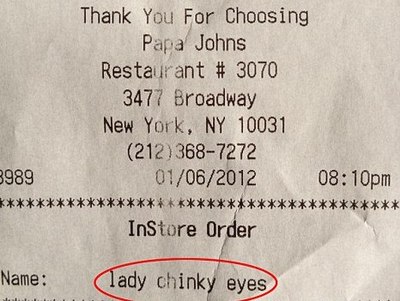
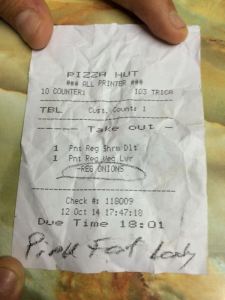
In 2012, a picture of Pink Fat Ladya Papa John’s receipt with its racial slur was retweeted 25,000 times in two hours. And in October, 2014 a similar incident happened at a Pizza Hut. These incidents generated huge press coverage for the wrong reasons for their brands and prompted apologies from the C-level of both companies.

Leadership development speaker Mark Sanborn posted in his blog about being told that to catch an earlier flight but with a downgrade from first class to coach, it still would cost him an additional $75. It didn’t matter that he was a United 1K Elite traveler flying over 2 million miles with United.

People Skills Coach Kate Nasser posted in her Smart SensAbilities blog about her confrontation with Karen, the manager at the Hilton Garden Inn in Eagan. When Ms. Nasser went down to catch the cab that would take her to her appointment, the cab driver asked for her room number. Of course, she didn’t want to give it to a complete stranger. So she asked the cab driver to come back into the hotel so that they could confirm her cab reservation. Ms. Nasser explains to Karen at the front desk that she did not want to give out her room number and could Karen confirm to the cab driver that she was the client for the reserved cab. Here’s the rest of that conversation:

Karen to the cab driver: “Her room number is 210.”
Ms. Nasser: “Excuse me, you just gave my room number to this man.”
Karen:  “The cab company requires it.”
Ms. Nasser, “You just gave this man my room number.”
Karen: “Nothing has ever happened.”
Ms. Nasser: “You just gave out my room number. How are you going to fix this?”
Karen: “Are you going to argue with me or are you going to get in the cab?”

Nick Meiers posted on his Essential Hospitality blog about this conversation he overheard in a restaurant:
Guest:  “How is the rib-eye?”
Server: “I’m not sure, I’ve never eaten here. You know how it is, you don’t want to be at work when you’re not working!”

I am convinced that in each of these incidents, these employees didn’t see anything wrong to act indifferently to the customer as they did. And here is the “killer” part.  In each of these cases, their manager or owner had no clue that these employees did what they did. Of course, the owner or manager would have handled each situation differently. But they weren’t there. At that moment, the reputation of the brand was in the hands of the one employee who was. And in each case, with the amplification by social media, the brand lost big time.

So what can you do to make sure you don’t have even one of these business-killing employees?

QUI ACTION STEPS:

  • Define customer service expectations during the onboarding process. Include customer service standards in each job description. Create and review your customer service manifesto with each new hire.
  • Use these poor customer service examples and those you read or hear about to remind your team of how the actions of just one employee can damage the business and brand. Discuss proper responses in handling similar situations that could arise in your business.
  • Take immediate disciplinary action when an employee displays rude behavior to a customer.
  • Share customer feedback, good and bad, regularly with your team. Involve your employees in defining alternative responses in handling the situations that generated negative customer comments.
  • Motivate your team continuously with daily huddles to keep focused on delivering exceptional customer service.
  • Constantly ask your employees if there are any incidents or questions that need to be resolved today so they can be better equipped to handle them in the future.
  • Empower your employees to bend the rules to take care of your customers.
  • Reward, recognize. and celebrate the random acts of kindness that individual employees offer your customers.
  • Serve as a role model to your employees when interacting with your customers directly.

When you do this you will keep every one of your employees involved, engaged and committed in only offering the kind of “killer” service for which you DO want to be recognized.

8 Comments

Filed under Customer Service

Do you have a Customer Service Manifesto?

Imagine if you could get each person on your team focused on the same vision and commitment to the delivery of the World’s Best experience for each customer. Your company’s service reputation would be broadcast so loudly by all of your customer loyalists that you easily would dominate your competition. So how do you do it? How do you get everyone on your team reading from the same book? Simple. Put it in writing. Literally let them read from the same book.

Create your customer service manifesto. Your manifesto is a declaration of your company’s customer service creed, principles and intentions. Do not confuse this booklet with the employee handbook. The latter defines the legal responsibilities of the company and the employee.  Your manifesto defines your company’s service culture. The employee handbook defines the limitations of personal performance. Your customer service manifesto defines the principles that each team member should aspire to perform. Big difference.

Why is writing your customer service manifesto so important? Review your company’s first day orientation agenda for a new employee. I am sure you will find that, while benefits are reviewed, much more time is spent on company policy – email and social media guidelines, conduct on and off duty, house rules, safety, sexual harassment, and on and on. It’s like saying to a new employee, “Welcome to the company. Now here is how you can get fired.” On the first day, you spend more time explaining the obstacles more than you do how to go above and beyond to wow your customer. What’s wrong with that picture?

Your manifesto will let your employees know that you are committed to service that is not hindered by rules. Discussed separately from the rules and regulations, you initiate new employees to fully grasp the value and importance of customer service. The principles within the manifesto define the level of service to which you wish each employee to aspire. So what are the components for a customer service manifesto? Here you go:

Mission Statement – Your mission statement should answer three simple questions: What do you do? How do you do it? Who is your customer?  Keep it short. Your mission statement should be memorable and easily recitable. Disney offers one of the best examples of a mission statement:  (What do you do?) We create happiness (How do you do it?) by offering the finest in entertainment  (Who is your customer?) for people of all ages, everywhere. It is simple, yet aspirational. What is your mission? Is it memorable? Can your employees get passionate about it?

Your Company Heritage – Most businesses give a new employee a historical timeline of major events. But a heritage is something more. A heritage incorporates the “why” behind the “who, what and when”.  A heritage is the storytelling of the rich tradition of your company. Marriott employees all know the story of newly wed J.W. and Alice Marriott’s trek from Salt Lake City to Washington, D.C., the nine stool Hot Shoppe where J.W sold 5 cent A&W root beer, and the sticky nickels hand carried to the bank by Alice Marriott. What is your company’s story?

Core Values – The core values for Baptist Health Care are Integrity, Vision, Innovation, Superior Service, Stewardship and Teamwork. Yum! Brands employees focus on CHAMPS: Cleanliness, Hospitality, Accuracy, Maintenance, Product Quality, Speed of Service. What are the pillars on which your company is built?

Appearance Standards – To the customer, the employee is the company and first impressions do matter. Your message here should convey that an employee’s appearance should be a reflection of your company’s professionalism and not an employee’s personal style.

Performance Tips – Define the specific behaviors that can guide employees to act courteously with customers in person, on the phone and on-line. Include in this section the forbidden phrases like “Honey, Sweetheart.” “I don’t know.” “You should have . . .” and “To be honest with you . . .” while offering performance expectations such as answering any ringing phone within three rings or an email within 8 hours, as well as using the person’s name at every opportunity. You know how to properly interact with customers. How do you want your employees to act? Tell them by writing it down.

Service Recovery – Marriott Hotels uses the service recovery acronym LEARN: Listen, Empathize, Apologize, Respond, Notify (your supervisor and co-workers so that it does not happen again to future customers). Other businesses use the acronym LAST: Listen. Apologize. Solve. Thank (the customer for bringing the issue to your attention). What are the service recovery steps that you expect every employee to take when confronted with a dissatisfied customer?

Experience Flow Chart – Jan Carlzon, then CEO of SAS Airlines, defined a Moment of Truth as “anytime a customer comes into contact with any aspect of a business, however remote . . . to form an impression.” Whether you call it an experience flow chart or experience journey map, plot all the emotional touchpoints of the customer’s experience. The employee can then be more aware of the key opportunities to wow your customers.

Aspiration page – This last page could be customer testimonials, motivational or customer service quotes or a parable like The Starfish Finder. (Google “Starfish Finder” if you haven’t heard of this story). This last page should serve as aspiration that one person truly can make a difference in the experience of a customer.

But merely writing and distributing the customer service manifesto at orientation is not enough. Spend time with the new employee to give your personal interpretation of the meaning and importance of the key components.

QUI TAKEAWAY: Samuel Johnson said, “People need to be reminded more often than they need to be instructed.” Ritz-Carlton established itself as one of the finest luxury hotel brands by mandating a daily line-up where that day’s Ritz Carton Credo card’s performance tip is reviewed. So refer to your manifesto often and ideally discuss daily one item within it  to instill in each employee your company’s mission, values, and performance expectations. And when you do, you will see that each employee will deliver consistently the World’s Best Experience to every one of your customers.

11 Comments

Filed under Customer Service, Training