Category Archives: Hospitality

Review: Micah Solomon’s new ebook: Culture Of Yes: Practices And Principles Of Great Hospitality

MicahSolomonMicah Solomon is a customer service and marketing speaker, strategist, and author of the book, High-Tech, High-Touch Customer Service. Ever since reading his book, I have been following his customer experience articles on Forbes. So when he recently published an ebook entitled Culture Of Yes: Practices And Principles Of Great Hospitality, I was all over it.  While I was quoted in the first chapter, I bought the Kindle version for the invaluable insight shared by some real hospitality heavyweights. And while this ebook is focused on those who are in the hospitality industry, I am sure that customer service professionals in any industry will benefit. Find out more about Micah and his new ebook at the end of this post.

A hotel’s associates have more impact in building the reputation of a hotel than the general manager. In one day, the associates have more direct interaction with the customers than the general manager might in one week. Yet, those associates can only deliver the level of service that they themselves have experienced. Many of them have never stayed at a hotel recognized for its exceptional service. Some of those associates may have graduated from a hospitality school. As a hotelier, I have interviewed my fair share of college graduates. These hospitality students have learned the technical parts of running a hotel – budget preparation and analysis, menu engineering, purchasing and inventory, property management systems, and sales and marketing. But rarely has the curriculum focused on the critical ingredient of a truly successful hotel operation, namely the art of hospitality, taking real care of the guest. So it is up to the manager to educate the associates and their junior managers on the principles of hospitality.

And if you are going to learn the principles of hospitality, shouldn’t you learn it from the best? Ask frequent travelers to name the best hotel chains and they will tell you Ritz-Carlton or Four Seasons. Or wouldn’t’ you want to know the secrets of the luxury resort properties that are frequently named in travel magazines as the very best like The Broadmoor or The Inn at Little Washington. Micah has interviewed the key executives from hospitality’s best, including others from Montage, Fairmont, EDITION, and Virgin Hotels and has published in this ebook their insights and, as a seasoned travel and customer service expert himself, those of his own.

Their collective insight focuses on all the key ingredients to deliver an exceptional guest experience – hiring the right people, developing the necessary internal systems and hospitality standards, creating the proper service culture, and defining steps for service recovery. Micah even discusses how technology has and will change the guest experience.

Busy managers may complain that they have no time to read an entire book on hospitality. Micah responds by offering bulletpoints at the end of the chapters, as he calls it, a “cheat sheet” to “begin learning from the best of the best – the greatest leaders and professionals from the very best lodging and foodservice organizations in the world.” That invaluable insight is offered from such hospitality icons as Isadore Sharp, founder and chairman of Four Seasons Hotels and Resorts, Herve Humler, president and COO of The Ritz-Carlton Hotel Company, and Danny Meyer, president and CEO of Union Square Hospitality Group. And if you want to be great at hospitality, then ask someone who has already proven that they are one of the hospitality greats. Micah has done that for you here.

While this ebook is directed to hospitality professionals, there is value for a manager of any business who has customers. Whether it is buying a Big Mac from a McDonald’s, a book from Amazon, or gasoline from your local Chevron station, you exchange money for a tangible product. Unlike retail, the hospitality industry is unique. In exchange for hundreds of dollars for a weekend stay, you check out of a hotel without receiving any physical item. You may have taken extra bottles of shampoo or even the bathrobe, but were they worth the price you paid for your room? Of course not.  The only “thing” you take with you is the memory of the experience. That experience has to be so memorable that you are willing to pay to repeat that experience again and again. In retail, almost any product can be replicated by your competitor. What can’t be replicated is the unique experience surrounding the sale of the product. So wouldn’t any retail business gain from the insight from hospitality where the experience is what customers pay for?  Of course it could.

You have heard, “Knowledge is power.” That is not true. It is what you do with the knowledge that is the power. So buy this book. Read it. And then do something to start delivering great hospitality for your guests or a great experience for your customers.
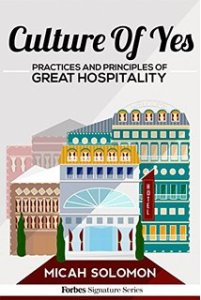
Culture of YesMicah Solomon is a keynote speaker, author, customer service speaker, customer experience consultant and company culture consultant. Find out more about Micah, his blog and his recent Forbes articles at http://www.micahsolomon.com . You can find out more about the ebook or purchase it from amazon by clicking on the book cover.

1 Comment

Filed under Customer Experience, Customer Satisfaction, Customer Service, Hospitality

Holly Regan: Richard Branson-Style Tips to Empower Your Customer Service Team

A while ago I had blogged about using the CASE Method to improve your company’s customer experience.  CASE stands for “Copy and Steal Everything”. If you feel uncomfortable with “Steal”, then “Copy and Save Everything”.  I said you should be more intent on observing within and outside of your industry for ideas that you can CASE. Then tweak the idea to make it your own.

I recently read an article in Software Advice’s Customer Service Investigator, which featured a discussion with Communications Coach and Author Carmine Gallo on some strategies for mimicking the customer service efforts of Richard Branson’s Virgin Group. While the tactics discussed are agreeably good ideas for promoting a strong customer experience, I wanted to further explore how other organizations could CASE Virgin’s best practices with the article’s author, Software Advice Managing Editor Holly Regan. You can learn more about Software Advice at the end of the post.

What is the risk involved with allowing customer service reps to operate within the “judgment playing field” (make their own decisions within boundaries)? How can other organizations comfortably adopt this tactic?

When you allow employees the freedom to make their own decisions, you open yourself up to the possibility that, occasionally, they will make the wrong ones. However, if you delineate clear boundaries for your judgment playing field ahead of time as to what employees are and aren’t allowed to do, you can ensure that even the occasional wrong decision won’t significantly harm your business. Defining these limits for acceptable behavior and communicating them to all staff members is one way organizations can feel comfortable about adopting this tactic. The other piece of the puzzle is smart hiring. If you have a strict screening process that ensures you only have people on staff who fit with your company culture and values, you can feel comfortable trusting them to make the right decisions.

Are there other benefits associated with instilling the company mission in all staff besides an improved experience for the customer – that is, do you find that employees also have a greater sense of purpose with knowledge of company goals and are willing to work harder?

Yes–instilling your company mission in all members of your staff not only allows them to deliver that mission to customers, it also gives them a higher-level view of what the company is trying to achieve through every customer service interaction. Employees who know what they’re working towards and why tend to work harder and are better able to internalize the mission and become passionate about it. They are empowered to deliver great service, regardless of their level of authority within the company.

Virgin’s employees are proof of this: customers of Virgin America and Virgin Atlantic laud the consistency of their service experience from boarding to baggage claim. The staff member checking them in for their flight portrays the same passion and enthusiasm as the flight attendant serving them in the air, because they’re both working towards the same mission. The Ritz-Carlton Hotel Company is another great example: everyone who goes through training at one of their hotels is immersed in the company mission, from basic etiquette to service psychology, and employees of every department are empowered to do whatever it takes to deliver on that mission. As a result, they are praised as some of the most passionate customer service reps in the world.

Which members of the customer service team should have an open door policy, and how does such a policy satisfy employees?

Anyone in a management position should have an open-door policy, from the shift supervisor to the CEO. Having a forum in which employees can provide feedback – and encouraging them to do so frequently and honestly – is crucial for any service-oriented organization. Management needs to have an accurate picture of what’s working and what’s not on the ground, and who better to provide that than the employees who are directly interacting with customers day-to-day? Your service reps are the best source of feedback on what customers like about your company, and what they need that they aren’t getting.

Having an open-door policy is not only helpful for management – it also shows employees that they have a voice and that their managers genuinely care about their needs, concerns and suggestions. Employees must feel truly valued in order to feel passionate about the company they work for. Managers must also make sure to communicate with employees about how their suggestions for improvement are being implemented or why they decided not to act on them. When employees know they aren’t just giving feedback in a vacuum, they’re more likely to keep providing it. And seeing their ideas put into practice is empowering and inspires them to always be looking for new ways to innovate in customer service interactions.

Customer service reps might find it difficult to “bring their personality” to work, as many are instructed to go off scripts. Should scripting not be so heavily practiced, or should managers encourage employees to simply integrate their own “personal touch?”

As mentioned in the article, customers don’t want to interact with a robot. Service is much more effective when it’s perceived as genuine, and scripting definitely discourages this. Instead of giving reps specific instructions for what to say and how to act, managers should focus on hiring quality employees who exude the company’s culture, mission and values – and who can be trusted to use their own judgment to deliver on that. By clearly defining the judgment playing field, you can ensure your employees don’t get too far off-track while also allowing them to interact naturally with customers, as they would with a friend or colleague. This not only gives reps the freedom to be themselves, it gives customers the benefit of a unique, memorable and genuine interaction that will keep them coming back.
software_advice_logo_v2Software Advice is a free online resource that reviews CRM, marketing automation and sales force automation software. Follow them at @CRMAdvice.

Leave a comment

Filed under Customer Satisfaction, Customer Service, Hospitality, Training

Ashley Furness: The Secret to Ritz-Carlton’s Customer Service Mojo

Prior to my present position as resort manager for Marriott’s Ko Olina Beach Club, I served as the charter general manager for The Henry – Autograph Collection (Autograph Collection is Marriott International’s exclusive portfolio of independent hotels) when it was reflagged after 21 years as the Ritz-Carlton Dearborn, MI (Ritz-Carlton is  a wholly owned subsidiary of Marriott International). Almost all the associates were former Ritz-Carlton “Ladies and Gentlemen”. Last year The Henry was recognized as one of Marriott International’s Hotels of the Year. I am convinced that while they are now The Henry associates they still would bleed Ritz-Carlton blue.  And if you’ve every stayed in a Ritz-Carlton hotel you know there is something extraordinary about the refined delivery of customer service by its associates. So when fellow customer service blogger Ashley Furness offered to share an interview she conducted with Diana Oreck, vice president of the Ritz-Carlton Leadership Training Center, I quickly accepted. You can find out more about Ms. Oreck and Ashley at the end of the post. But for now, here is Ashley’s inside look at how Ritz-Carlton educates its associates to deliver its world-class brand of exceptional customer service.

The Ritz-Carlton Hotel Company is known worldwide for it’s “legendary service.” So much so, Apple uses the luxury hospitality brand as a model for its owner customer support traditions. For both, it’s all about anticipating the customers’s expressed and unexpressed needs.

These practices have not only increased word of mouth and brand loyalty. Ritz-Carlton also boasts among the best employee retention rates around. To create raving fans, they start with inciting brand enthusiasm from their team.

Recently, I had the privilege of interviewing Ritz-Carlton leadership training center Vice President Diana Oreck. I asked her about customer service training, retention, performance measurement and more. Here’s what she had to share about Ritz’ super service sauce:

What sort of questions can you ask someone to find out if they’re caring and can anticipate customer wants and needs?
Well what you want to make sure you do is not ask yes or no questions. You’re not going to say, “OK Ashley, are you a caring person?” Because obviously, you’re just going to say yes, right? So what we do is we ask you in the interview, “Ashley give us a specific example of how you’ve cared for someone in the last month.” “Give me a specific example of anticipatory service that you have extended.”

Ritz-Carlton puts a lot of emphasis on successful new hire orientation. Why is this important for customer service training?  

A lot of companies have a notion that employee orientation really needs to be a data dump of the company, and statistics and who’s doing what. It really isn’t. What we are looking for at orientation is passion. We want to make sure that that new person gets the feeling they made the right decision in joining us.

It’s all about them and it’s all about culture. We feel that orientation needs to be significant emotional experience. Because think about it – you are making  a very big decision in your life to either start a job or change a job. So our two days of orientation, they are solely revolving around our culture, which we call the gold standards. And the reason we do that is we know that the culture creates passion advocates of our employees. Raving advocates of our brand and we don’t think that it’s realistic to ask that your customer be passionate, raving fans if your employees aren’t first.

Is this also something that helps with customer service employee satisfaction and retention?

Yes, it’s about engagement. I will give you an example. The lodging industry as a whole tends to run a 60-70 percent turnover in a year. Here at Ritz Carlton we run in the low 20s. It’s a huge difference.

What else do you do to promote retention?

We’ve got a vast list. Rewards and recognition is huge. Ranging from first class card, which is the most popular form of recognition at Ritz Carlton. Talk about less is more, it’s just a card that says “first class” and we give it to each other to thank each other. It can be peer to peer, peer to manager, employee to president, president to employee. And then we have things like birthdays, we give gift certificates. You can become five-star of the quarter. We don’t do employee of the month, because we find it’s much for meaningful if it’s the quarter. We are also one of the only hotel companies that still provide meals for their staff. We have gorgeous picnics in the summer and the holiday party and it goes on and on.

What metrics or qualitative data does Ritz-Carlton use to measure customer service training success (How do you know it’s working)? How do you collect this data?

Oh yes, we poll our guests once a month. The Gallup organization sends out 38 percent of guests that stayed the month before. It’s done randomly with the hope we will get 8-10 percent return. We live and die by that guest engagement number. This is the sum of responses to about 30 questions, including How likely is that guest to recommend Ritz Carlton? Were they delighted and satisfied with their stay? If there was a problem, did we take care of their problem? We know that if that guest engagement number goes up, we know that our training programs have been successful.

What are the biggest mistakes companies make when training customer service staff?

There not being specific enough. They’ll say things like “Give great service.” Well that’s nice, but people need a road map. Never assume anything, make sure you have your service standards written down and allow people to observe you in action. Don’t assume that their mother or father, or previous employer taught them what really great service looks like. Have a written service strategy.

What other successful customer service strategies have companies adopted by studying Ritz-Carlton?

It’s all about empowerment. The thing that our guests are most wowed about is that every single employee has $2,000 a day per guest to delight, or make it right. But we never use the money because that money is just symbolic. We are saying to our employees we trust you. We select the best talent. Just help the guest. We do a lot of training around empowerment. So I would say this – you need to empower employees. You also need to make sure that you are inspiring employees to bring their passion to work everyday and to volunteer their best. And you do that by reinforcing their purpose, not their function. Not the how to do your work, but the why of the work you do.

About Diana Oreck
Diana Oreck is Vice President, Leadership Center and leads The Ritz-Carlton’s two-time Malcolm Baldrige National Quality Award-winning corporate university.  She brings more than 30 years of experience in hospitality to her role and was named as a 2011/2012 Woman of the Year by the National Association of Professional Women. Under her leadership The Ritz-Carlton Hotel Company was named the best global Training Company in the world in 2007 as ranked by Training Magazine.

About the Author

Ashley Furness is a CRM analyst for Software Advice. has spent the last six years reporting and writing business news and strategy features. Her work has appeared in myriad publications including Inc.Upstart Business Journal, the Austin Business Journal and the North Bay Business Journal. Before joining Software Advice in 2012, she worked in sales management and advertising. Currently, her research focuses on various topics related to CRM software, sales, customer service and marketing strategy. Follow her on Twitter @AshleyFurness.

4 Comments

Filed under Customer Loyalty, Customer Service, Hospitality, Training

I Know Ritz-Carlton and You’re No Ritz-Carlton

We are Ladies and Gentlemen serving Ladies and Gentlemen.
Ritz-Carlton Motto

We recently decided to visit a golf resort here in North Michigan. It touted having spent $14 million dollars in renovations. While it is the off-season, as a former resort general manager, I still wanted to check out what was new and different. (Yes, it’s what resort GM’s do on vacation.)

Walking through the brand new lobby, we approached the front desk. The agent asked me for my last name. I said, “It’s KEY-sing. Starts with a Q-U-I”. She looked down at her computer, typed the letters, then looked right up at me, and asked, “How would you pronounce that?” Seriously. Then she asks me for a photo ID. Now I know that the controller wants to catch the one guest out of 10,000 who might scam the resort, but for the other 9,999 of us, you’re basically telling us that you don’t trust us. Not a great first impression. After proving to her that I was actually who I said I was, she gave me the room key. While I may have rolled in my luggage, I could have used bell assistance to tell us how to get to our room. No such luck.

I was struggling in front of the room with four pieces of luggage, having propped the door with one of them, when a room service attendant passed by. She smiled and then practically sprinted by me to catch the elevator before it went back down.

After a three-hour drive, we weren’t up for being cloistered in the room ordering room service. So we went back downstairs and found out that the only two outlets open for dinner were the fine dining restaurant and the sports bar. We weren’t dressed for elegant dining, but when we went to the Sports Bar, it was so poorly lit that it looked like a cave lighted only by the big screen TV. The menu was limited to bar food appetizers. So we opted to travel into town.

I’m a souvenir collector when it comes to vacations, so the next morning  I walked to the brochure rack next to the bellstand to pick up a resort brochure. There were three bellpersons talking to each other near the stand. And while I was scrutinizing the rack to find a brochure that wasn’t there, none of them offered assistance. Rather than disturb them, I walked away. Never did get a brochure.

At checkout, the only parting remarks from the front desk agent was, “You’re all set.”

Nobody raves about average, but everybody rants about nothing. While I liked the new Great Room lobby and appreciated the flat screen TVs and free Wi-Fi, I have come to expect that in a first-class resort. So I’m really not inclined to jump over to TripAdvisor to give them a Five Star review. In fact, I’m ranting in this post to say that the resort actually fell short in service. When I pay more for a king bedded room in one resort than the same size bed in another resort in the same area, I know I’m not paying the premium for the product or the setting.  I’m paying more because I think the services offered are going to be better. So I have high expectations of what that service should look and feel like. Unfortunately, my actual experience didn’t meet my expectations. It would have been “nothing” for the front desk agents or bell attendants to personalize my arrival and departure experiences. It would have been “nothing” for the room service attendant to lend a hand in helping me move the luggage into the room. Not exactly Ladies and Gentlemen serving Ladies and Gentlemen. In doing their jobs and nothing more, they were average. And nobody raves about average. Disappointed that my experience did not meet my expectations, I rant about the “nothings.”

People are willing to pay much more of a premium to stay at a Ritz-Carlton. And despite paying that premium, people still rave about the exceptional service delivered by the Ladies and Gentlemen of Ritz-Carlton. So what is their secret? Actually it’s not a secret, at all. Ritz-Carlton gives us the blueprint to their success. Simply Google “Ritz-Carlton service” and you will find any number of articles written about the subject or the Amazon listing for Joseph Michelli’s book about Ritz-Carlton, The New Gold Standard. Better yet, go directly to the Ritz-Carlton page on their website that defines the brand’s Motto, Credo and Gold Standards. You also will find the foundation for their exceptional service in The Three Steps of Service:

A warm and sincere greeting. Practice the 10-5 rule. At 10 feet, acknowledge the customer with eye contact and at 5 feet, greet the customer with “Good morning/afternoon/evening” and a smile. Use the customer’s name after it’s been given whenever the opportunity arises.

Anticipation and fulfillment of each guest’s needs. Define customer expectations of the timeline of touchpoints during the customer experience. First remove all the potential dissatisfiers that could displease a customer. Then proactively look for opportunities to create a “small wow” that goes above the customers expectations. It could be something as simple as assisting a customer you may see standing in front of the store directory or looking up at the store directionals.

Fond Farewell. Sincerely thank the customer for choosing you and offer a warm good-bye. Again, use the customer’s name once it’s been given. Better yet, consider an after the sale follow-up phone call or thank you note.

Seems simple enough: Warm welcome, Magic Moment, Fond Farewell. But if it’s that simple, why, then, isn’t customer service everywhere like Ritz-Carlton? The real secret is in the huddles held daily in each department in every Ritz-Carlton and consistent execution of The Three Steps of Service by their Ladies and Gentlemen. So to build your customers’ perception that your service is dependably exceptional, then perform the Three Steps of Service courteously in your personal delivery of service with each customer every day. If you are a customer service leader, remind your Ladies and Gentlemen daily of The Three Steps of Service and recognize and celebrate frequently those you see deliver The Three Steps to your customers.

QUI TAKEAWAY: Make this common sense Three Steps mantra – a warm welcome, anticipation and fulfillment of each customer’s needs and a fond farewell – truly common practice with your customers and you’ll soon be earning a reputation for service like Ritz-Carlton.

15 Comments

Filed under Customer Experience, Customer Satisfaction, Customer Service, Hospitality, Training

GREAT Service is GREAT Theater. Don’t be just good. Be GREAT out there out there!

In their book, The Experience Economy, Joseph Pine and James Gilmore define that “Work is theater and every business a stage.” If you were an actor delivering a great live theatrical performance, the audience becomes wrapped up in the experience and as they walk out of the theater, they are telling their friends that it was the best thing that they’ve enjoyed in a long time.

It does not matter to the audience that the actors are performing for the 100th time. The audience has paid very good money to see the show and expects the actors to deliver their performance with the same passion as on opening night. Your customers expect nothing less. As it is in Great Theater, you have to “act it like you mean it”. Do not confuse this with “fake it till you make it”. Your customers, like any audience, can see right through that kind of performance. Do you always feel like working every day, five days a week, 8-10 hours a day, on your birthday,  holidays, or even on scheduled days off? Of course not. But do you think the customer really cares how you feel? Absolutely not! No customer walks into your establishment and says, “Dissatisfy me now”. So you have to deliver Great Theater every day whether you feel like it or not.

When you perfect the delivery of the script, you perfect your performance. Break down your customer experience, act it like you mean it, and deliver Great Theater. For example:

ACT ONE. Scene One.

 The Customer enters from offstage.

SERVICE PROVIDER: “Good afternoon, how may I help you?”

Motivation: Never say “May I help you?” If the customer is standing in front of you, he obviously needs help or he would have bypassed you completely.

CUSTOMER: “I believe I have a reservation. Last name is Smith.”

SERVICE PROVIDER: “Yes, Mr. Smith, we’ve been expecting you. Welcome to The Best.”

Direction: Maintain eye contact for at least seven seconds and smile as you say your lines.

Motivation:

  • As Dale Carnegie says in his book, How to Win Friends and Influence People, “Remember that a person’s name is to that person the sweetest and most important sound in any language.” So start with the customer’s name.
  • What do you think is the very first question running through the mind of a customer when coming up to an airline counter, front desk, host stand, or reception desk? That question is, “I wonder if they have my reservation?” So to establish a great first impression, incorporate this statement into your welcome, “We’ve been expecting you.” It immediately removes that mental dissatisfier and puts the customer at ease.
  • Follow that up with the name of your business.

Let it all flow together.

“Mr. Smith” (you’re very important to us). “We’ve been expecting you.” (No need to worry about your reservation. We have it.) “Welcome to . . .” (Where did Mr. Smith feel the most comfortable in interacting with a company? With you, of course. )

QUI TAKEAWAY: Define each scene in the customer experience and practice it often offstage. Never practice on the customer. Role play with your colleagues. Then perform your role so well that all your customers say to themselves and others that your service was the best that they have enjoyed in a long time. And when you deliver that kind of Great Theater performance consistently, you will build repeat business and customer loyalty.   

QUI QUOTE: GREAT Service is GREAT Theater. Don’t fake it till you make it. Act it like you mean it. Don’t be just good. Be GREAT out there!  

#customerservice #customerexperience #custserv #custexp #cx


1 Comment

Filed under Customer Experience, Customer Loyalty, Customer Satisfaction, Customer Service, Hospitality

Your voice mail greeting is costing you business.

Angry Business Man Hears Something Annoying on His Phone

Of course, the best customer service is to have any person answer any phone ringing. But if you’ve decided that voice mail is acceptable, does your voice mail greeting sound something like this: “This is (My Name). I am either away from my desk or on the phone. . . ”  or “You have reached the office of . . .” or “You have reached the desk of . . .”  If yours sounds like any of those, then your voice mail greeting is costing you business.

Be your customer:

  1. In a phone conversation, there are two people on the line – your customer and you. With your greeting, of the two of you on the phone, who are you saying is more important – you or your customer? If you have one of those “I am either away from the desk or on the phone” you’re saying to your customer, “I’m so important that I have to tell you where I am even when I’m not here.” Now really, do you think your customer cares what you’re doing when you can’t take his call? Really?
  2. Do you really want your customer to think that you believe your office or your desk are animate objects that actually answer the phone on your behalf? Your customers don’t want a relationship with your office or your desk. They want one with you.
  3. When your customer calls you, do you think he really wants to get your voice mail?

Remember, the customer is paying for his experience, not yours. Whatever you think is your reason you give on voice mail for not answering the phone, whether you really are away from your desk or on the phone – your experience – is still perceived as an excuse by your customer for not being there – his experience.

So what should it sound like? How about something like this:

“At Your Service, this is Your Name, Your Position for Your Company. I apologize that I’m unable to take your call personally at this time. Press the one key at any time to begin recording. My email address is SPELL OUT YOUR NAME @Your Company. If you wish, please leave your name and number and the best time to contact you, and I will return your call. Thank you for calling.”

“At Your Service” . . . It’s a reminder to your customer that you understand what your role is in the business relationship. And it will certainly differentiate you from your competition.

“I apologize . . .” What the customer is hearing is: “Since I’m not here to speak to you as you expected, I want to apologize. . .”

“ . . to take your call personally . . .”. Customer service is all about relationships. Given a choice, people would always prefer to buy from people they know, like, and trust.  And people like and trust more those people who personalize the experience for each individual customer.

“Press the one key. . . ” so that they know what to do on future calls.

“My email address . . . “ Rather than play telephone tag, many callers who can’t connect with you on the phone will send an email immediately after hanging up.

“Thank you for calling.” People also buy from people who want their business. How do you show someone you want their business? Just say “Thank you.”

There is one group who will read this and say to themselves, “Boy, that’s over the top. It’s not that big of a deal. It’s only voice mail. I’ll just stay with my greeting.” There is another group who will read this and will say to themselves and others who work in their organization that they will adopt my VM greeting example because it removes a potential customer dissatisfier. They understand that they cannot begin to truly satisfy a customer until they remove all the potential dissatisfiers. That second group makes every effort to remove any potential dissatisfiers, even what they believe may be a small one because they “think like their customer.” And if it’s a big deal to the customer,  it’s a big deal to them. And that second group, well, they’re competing with the first group for the same customer and differentiating themselves from their competitors. Which group are you in?

Leave a comment

Filed under Customer Service, Hospitality, Marketing, Training

To be the World’s Best, Be Your Customer.


How do you get your customers to feel that their experience with your business is so over the top that they want to tell the world? For them to be WOWED, answer this question for your customer “What would World’s Best look like?” or “WWWBLL”. The “World’s Best” experience is not as “the world” sees it, but as the customer personally feels it. 

The customer pays for their experience. And they seek the best value in their experience for the price you ask them to pay. So a person living in Detroit having a five-figure salary feels the best value isn’t a luxury plane to the Swiss Alps, but rather a four-hour drive to Boyne Mountain.

Once you understand the expectation of WWWBLL for your customer, then you need to deliver that experience consistently. There are Three Principles to answering the WWWBLL question: Be Your Customer. Create Their Experience. Be the Difference.

Principle One of the WWWBLL Experience: Be Your Customer

To your customers, their perception is their reality. Jan Carlzon, then president of SAS Airlines, coined the phrase “Moment of Truth,” which defines any time a customer comes into contact with any aspect of a business, and based upon the collective sum of those “Moments of Truth” forms an unshakeable perception of that company.

Why is the male grooming standard at Disney theme parks so strict? If children are not brought to Walt Disney World by their parents, they are brought by their grandparents. Ask Grandma if she would leave her grandchild in the care of the teen attendant with visible body tattoos, long hair, unshaven beard, and multiple body piercings – a Moment of Truth. Grandma may not say it, but she certainly thinks, “Of course not! If he’s not doing drugs, he’s probably selling drugs.” That attendant could be Disney’s Cast Member of the Month. It doesn’t matter. Grandma’s perception is her reality.

If you dine in a restaurant for the first time and have a decent meal, but, in the end, step into the restroom – a Moment of Truth – and you find it filthy, you may not return. You are thinking, “If the owner doesn’t feel restroom cleanliness is important, he probably doesn’t think it’s important in the kitchen either.” Your perception is that if the restroom looks and smells this bad, how clean could the kitchen be? And your perception is your reality.

Customers buy with emotion and justify that decision with reason. Customers are willing to pay a premium because it makes them feel better emotionally. Think about a Four Star resort spa experience. The reality is that you will go into a private room and take off all your clothes. A complete stranger is going to come into that room and for fifty minutes touch you all over your body. And for that experience, you pay the spa about a hundred dollars. Realistically why would you do that? Because emotionally you believe you feel so much more relaxed, it was worth it. Your perception is your reality.

If you want to relax at home, envision yourself in a “Calgon, Take Me Away” moment, soaking in a bubble bath, surrounded by candles, listening to Kenny G. You can go to any dollar store and buy a pack of ten emergency candles for a dollar. That makes each candle just ten cents – very reasonable. But for some of you, that is laughable. If you are going to relax, dollar-store candles just won’t do. You’ll return to that spa and get one of their scented candles. The spa sells candles for ten dollars each. You could get one hundred dollar-store candles for just one spa candle. One hundred candles! You could have a bonfire in the bathroom with those candles! But which candle would make you feel better? You’d say it’s because the spa candle smells like mango-papaya. You could return to the dollar store to buy air fresheners, pop them open, and put them all over the bathroom. But you’d respond that it just wouldn’t feel the same as how the spa candle would make you feel. Your perception is your reality. You, being the customer, are willing to pay a premium because it makes you feel better. Now you are being your customer.

QUI TAKEAWAY: Your customers’ perceptions are their reality and they buy with emotion. Their expectation of customer service is no different. Maya Angelou said it best, “People will forget what you said. People will forget what you did. But people will never forget how you made them feel.” If your customers’ Moments of Truth interactions with your business are “wow’s” and, in the end, they feel great, they will be sure to tell their world of family and friends. So how do you create an experience that will emotionally bond your customer to your company?

#customerservice #customerexperience #customerloyalty #custserv #custexp #cx

Leave a comment

Filed under Customer Experience, Customer Loyalty, Customer Satisfaction, Customer Service, Hospitality

Thank you, Mr. Marriott.

You know you are getting older when, instead of attending birthday parties and weddings, you are attending funerals. I’ve come to realize that some of the greatest stories about individuals and their impact on others only seem to come out in the eulogies. Before I get any older, I wanted to express my admiration and appreciation for the example Mr. Marriott gave me as a leader and how it has formed my management style.

While still in college, I joined Marriott in 1976 as a charter member of Marriott’s Great America in Santa Clara. And just 5 years later, I was fortunate to serve as the opening director of services for Marriott’s 100th property, the Maui Marriott Resort, the first in the state of Hawaii. What I remember to this day was how Mr. Marriott would walk the backstage areas and greet everyone with a smile and a handshake. He didn’t wait for someone to approach him. He initiated the interaction. As managers, we all went through orientation where we learned the mantra of J.W. Marriott, Sr., “Take good care of your employees and they’ll take good care of the customers.” And in the gesture of Mr. Marriott, Jr. walking around to introduce himself to all of us, it was obvious the mantra wasn’t simply a slogan, but really something that drove the leadership philosophy of the company. While I left Marriott shortly thereafter I always remembered that example.

Eight years ago, while I was general manager, The Inn at Bay Harbor became the first Renaissance franchise in Michigan. While Mr. Marriott was not able to attend the conversion ceremonies, the regional team, all of the same generation as Mr. Marriott, exhibited the same genuine warmth in greeting all our associates and welcoming them to the extended Marriott family. And every Marriott regional VP has done that with every subsequent visit. That gesture was very apparent to me because I had not seen that kind of management culture since leaving Marriott.

Thirty-five years after my first day at Great America, I was the charter general manager of The Henry – Autograph Collection which for 21 years stood as the Ritz-Carlton Dearborn. Mr. Marriott came through on a tour of the property. Since The Henry is a franchise, he did not have to do that during his two-day tour as there are many Marriott managed properties in Detroit. But he did. Serving many years as a Board member of General Motors, he had visited often when it was a Ritz-Carlton. Many of the same associates were there to greet him on his first visit to The Henry. We had the line of associates upon his arrival and he took the time to shake everyone’s hand. But what I remember was that on our tour of the property, he made it a point to acknowledge every associate as he had done in Maui.

Between my days in Maui and my time at The Henry, I have worked for other corporate hotel companies and had the chance to meet very senior staff and had them visit my properties. I can tell you that the genuine appreciation that Mr. Marriott shows on every visit to every associate just doesn’t happen in other hotel companies. And there just doesn’t seem the sense of collaboration, that “we are in this together” feeling that Marriott leaders create. The lesson here: It all starts at the top. A handshake and a smile from the Chairman may seem like a very small thing, but it certainly made an impact on my leadership style. From day one, I understood you simply can’t lead from the corner office.

I am sure many Marriott current staff and alumni have stories on how Mr. Marriott and Marriott International have affected their lives. What’s yours?

1 Comment

Filed under Hospitality, Leadership

Remove all the dissatisfiers: FORBIDDEN PHRASES

“Customers perceive service in their own unique, idiosyncratic, emotional, irrational, end-of-the-day, and totally human terms. Perception is all there is!” Tom Peters.

Your Number One work responsibility is to WOW new customers and have customers return loyally, raving to others. So, how do you do that? Be the customer. The customer pays for his experience, not yours. To them, image is everything, perception is reality, and feelings are facts. They buy with emotion and justify that decision with reason. So he seeks the best emotional value in his experience, not your logical best price, service, or product. When your customer interacts with you, you are not representing the company. You ARE the company. And, as the company, you cannot begin to satisfy customers until you remove all the potential dissatisfiers. That means removing Forbidden Phrases. Forbidden Phrases are those that could potentially give a customer a bad impression of you and your company. The customer seeks his best value, and, bluntly, one of the Forbidden Phrases is a poor one. Here are just a few:

“I’m new here.” “I’m in training.” “It’s my first day.” Be the customer. If you’re going to pay your hard-earned money, do you want to be served by a rookie? Your customer is no different. Saying that you’re new is your experience. The customer is seeking the best value for their experience. When you say you’re in training, your service is a poor value for his experience. Even more, customers don’t care about your experience. All they care about is their experience. 

PROPER: Simply don’t use these phrases. The customer seeks a GREAT experience, and you simply want to give it to them as best you can.

“You’ll have to go to (call) …” The customer pays for his experience, not yours. He doesn’t HAVE TO do anything.

PROPER: You may have said, “Could you go to (call ) …”, but he might have a “pass onto pass onto pass onto …” negative experience.

It’s best to say, “Let me walk you to the call…” and do it quickly.

“To be honest with you …” What is the customer hearing? “… because I lie to you the rest of the time.”

PROPER: Simply do not use any of these phrases. You’re not lying to him because you haven’t said anything. And the best value for the customer’s experience is one that is quick, easy, and painless. 

“That’s not my job.” Be the customer. “Well, it looks like you work here. Why isn’t it your job and why don’t you find the person who does?” 

“I don’t know.” When you say “I don’t know,” you are saying to your customer, “I don’t know. They didn’t train me well, and this company always keeps me in the dark.”

“I think …” or “I believe …” “What time does the mall across the street open on Sunday?” “I think 11 a.m.” Here is what the customer is hearing you say, “I have no clue, but here is my best guess… “

PROPER PHRASE: “That’s a great question. Let me find out for you.” The best value for the customer is an experience when they feel they have all a great question.

“Okay.” Your customers may be parents. When they asked their six-year-old, “Are you going to clean your room before dinner?” and the child said, “Okay,” what were the parents thinking? When the parents asked their sixteen-year-old, “You’re going to be home by midnight, right?” and the teen said “Okay,” what do you think the parents were thinking? “Okay” to them means “Maybe. Maybe not.” So when you say “Okay,” the customer is hearing “Maybe. Maybe not.” Or he is hearing “Okay,” which means “good.” So your customer feels your service is good, not better, just average. Nobody raves about average. 

“No problem.” Your customer has every expectation that his experience will be problem-free. No customer ever calls or walks into your establishment to proclaim, “Here I am. Here’s my money. Dissatisfy me now.” When you say, “No problem,” your customer is thinking, “Why? Was there a possibility that it would be a problem? At the same time, “No problem” means “no problem to you.” What you are saying to your customer is, “Of the two of us, I am the star of the show. And you are asking something so small that it is no problem.” Not exactly customer-centric, are you?

“Okay” and “No problem” are saying to the customer, “We will meet your minimal expectations”. And since you are intent on delivering outstanding service, should anything simply be “okay” or “no problem”? Of course not.

PROPER PHRASE: “Certainly.” His experience is not just “okay” or good, without a problem or just satisfactory. It’s “certainly” better.

“That happens all the time.” For example, “The hotel key you just gave me doesn’t work on my door.” “Oh, that happens all the time.” Here is what the customer wants to ask, “Well, if it happens ALL the time here, why don’t you FIX it?”

PROPER PHRASE: “I apologize.” (More on this below.)

“Our policy is …” Be the customer. Here is what the customer is hearing you say, “What I am about to tell you will cover us. You’re simply not going to like it. But that’s your problem.”

PROPER PHRASE: Explain what the policy is, but don’t use the word “policy.”

“I’m sorry. We’re a little understaffed.” or “Someone called in sick today.” or “I’m sorry” plus any reason why you were unable to deliver.

Customers do not expect to be dissatisfied when they walk into your establishment. Any explanation you give about why you did not meet their expectations is not being heard as a reason. It’s being heard as an excuse. They don’t want an excuse. Customers are paying for their experience, not yours. “I’m sorry” is your experience. Bluntly, they don’t care how you feel. What’s in it for them? Customers want action, not excuses. At the very least, you should give him an apology.

PROPER PHRASE: Simply say “I apologize,” with no excuses, and do whatever it takes to work towards a resolution, even if it means recommending him to your competitor. Don’t “fire” the customer. Simply ask him to “resign.” “I apologize, but we can’t find a solution for you. Could I recommend this company (your competitor)? I could call them if you like.” Both are happy. The customer is happy because you found a quick fix. He has an emotional connection. The more emotional the connection, the more memorable the experience, the more loyal the customer. Ideally, the customer will remember and return later. The competitor is happy because you referred a customer to them. The competitor may refer a customer to you when they can’t fix a problem. A Mutual Admiration Society of sorts. 

QUI TAKEAWAY: Are there any Forbidden Phrases that are specific to your industry? “Checking in? or “Checking out?” for hotels. “Just one?” or “Are you done with that?” for restaurants. Identify and eliminate them from conversations with your customers, and you will be on your way to delivering a problem-free, exceptional experience for them.

Leave a comment

Filed under Customer Satisfaction, Customer Service, Hospitality, Training

Word of mouth advertising is NOT the best form of advertising.

I ask my audience, “What is the best form of advertising to build market share?” Invariably, almost everyone responds “word-of-mouth.” Yet I tell them they are wrong.

The reach of word-of-mouth has gone well beyond just family and friends. People are turning to the internet to use sites like Yelp, TripAdvisor, and even Facebook to make buying decisions. While the reviews and advice are virtual, it is still word-of-mouth advertising. Customers do it and most likely with technological advances, will do it even more. While customers don’t know any other customers, they trust their reviews. Michael Angelo Caruso, leadership and communication consultant, says it like this: “If I tell you how great I am, it’s advertising. If someone else tells you how great I am, it’s the truth.”  Customers trust the reviews and ratings of complete strangers over advertising. But here’s the catch. Customers not only are looking at the good reviews. They’re making a no-buy decision on the poor reviews, too. For example, if a customer is looking for a hotel, he may veer away from one that has customers post reviews of paper-thin walls or poor housekeeping. A bad review will hurt you more than a good one will help.

So simple word-of-mouth, be it in person or on the internet, is not the best form of advertising. The best form of advertising is “positive word-of-mouth.”

There are three things that happen after you do business with a customer.

  1. You do not meet the customer’s expectations. The customer is dissatisfied, never saying anything to you, but rants to everyone, including those he does not even know.
  2. You meet his expectations but, in his mind, did nothing to set you apart. He may be satisfied, but he tells no one.
  3. You exceed the customer’s expectation where he wants to continue to do business with you. Not only does he loyally return, he raves about you to others, even those he does not know.

QUI TAKEAWAY: It takes more than meeting a customer’s expectations to drive positive word-of-mouth advertising. Satisfied customers feel their experience is good, not better, just average. Nobody raves about average. And satisfied customers will leave when they find something better or less expensive. Exceeding customers’ expectations is the only outcome that actually builds your business. In order to become raving fans, customers must experience an interaction that is simply over the top. They must walk out your doors and say “Wow! That’s the best thing that has happened to us today.” Without the “wow” there is no rave review. And if you are not generating rave reviews, you simply are not generating enough positive word-of-mouth advertising to build your business. So, today, don’t treat customers as they would have expected. And don’t treat them more than they want to be treated. Instead, treat them a little better than they want to be treated. Don’t serve to sell. And don’t serve to satisfy customers. Instead, serve to WOW them. Serve to CARE. Be Magnificently Boring! And Be GREAT out there!


Leave a comment

Filed under Customer Experience, Customer Satisfaction, Customer Service, Hospitality, Training